
Introduction
A thread is a single stream of execution inside a process. A traditional process has one thread; a multithreaded process has several, all running the same program in the same address space. A web server can serve each request in its own thread; a word processor can check spelling in one thread while another reads the keyboard.
Threads exist because processes are expensive to create and switch, and because processes cannot share memory without extra machinery. Threads of one process share code, data, heap and open files, so they communicate through ordinary variables and switch with less work. The price is that shared variables now need synchronization, which is the subject of The Critical-Section Problem.
What threads share and what they own, user-level versus kernel-level threads, the three multithreading models, and the effect of blocking system calls and multiple cores are the distinctions that matter; Amdahl's law bounds the speedup from extra cores.
Prerequisites
- Processes, PCB and Process States: PCB, context switch, process states.
Core concepts
Shared and private
| Shared by all threads of a process | Private to each thread |
|---|---|
| Code (text) | Thread ID |
| Global and static data | Program counter |
| Heap | Register set |
| Open files, current directory | Stack (and so local variables) |
| Signal handlers, user and group IDs | Scheduling state and priority |
| Address space (page table) | Thread-local storage, if used |
Locals are private, globals and heap are shared. A local variable of a thread function lives on that thread's stack. Passing its address to another thread makes it reachable, but it is still memory on the first thread's stack and disappears when that function returns.
A thread control block holds the private part (registers, PC, stack pointer, state); the process's PCB holds the shared part.
Why threads
- Responsiveness: one thread can block while others continue.
- Resource sharing: no IPC needed for shared data.
- Economy: creating a thread and switching between threads of one process is cheaper than for processes, because the address space (page table, and often the TLB contents) does not change.
- Scalability: threads of one process can run on different cores at the same time.
Concurrency versus parallelism. Concurrency means several tasks make progress over the same period, possibly by interleaving on one core. Parallelism means several tasks execute at the same instant, which needs several cores. A single-core system can be concurrent but never parallel.
User-level and kernel-level threads
| Property | Many-to-one user-level threading (M:1) | One-to-one kernel-scheduled threading (1:1) |
|---|---|---|
| Managed by | A thread library in user space | The kernel |
| Kernel knows about them? | No; it sees one process | Yes; each is scheduled separately |
| Create and switch cost | Very low: a procedure call, no mode switch | Higher: system call and kernel scheduling |
| Blocking system call by one thread | Blocks the whole process (all its user threads) | Blocks only that thread |
| Use of multiple cores | No: the process gets one kernel thread at a time | Yes |
| Scheduling policy | Application-specific, chosen by the library | Kernel's policy |
Multithreading models
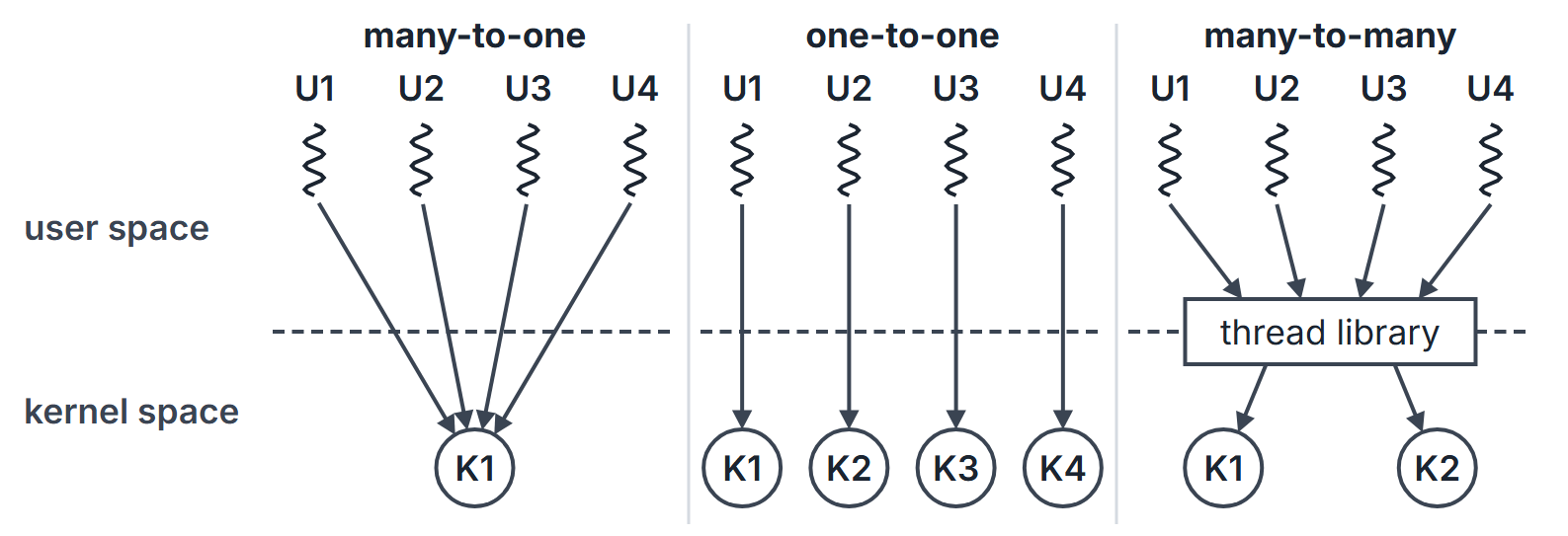
The models describe how user threads map onto kernel threads.
| Model | Mapping | Blocking call | Parallelism | Examples |
|---|---|---|---|---|
| Many-to-one | Many user threads on one kernel thread | Blocks all | None | Early Solaris "green threads" library |
| One-to-one | Each user thread has its own kernel thread | Blocks only the caller | Full | Linux and Windows thread implementations |
| Many-to-many | user threads multiplexed on kernel threads | Another kernel thread can run the rest | Up to at once | Older Solaris, some research systems |
The two-level model is many-to-many that also allows some user threads to be bound to their own kernel thread. One-to-one dominates today because cores are plentiful and kernel threads are cheap enough; its cost is that creating very many threads creates very many kernel objects.
How it works: Pthreads
POSIX threads (Pthreads) is a specification, implemented as a library, that may be one-to-one or other.
C11 guarantees long can represent at least -2,147,483,647 to 2,147,483,647; the sums below use long, while thread IDs remain int. Assume the displayed thread creation and join calls succeed.
#include <pthread.h>
long sum[2];                          /* shared: global */
void *worker(void *arg) {
    int id = *(int *)arg;            /* id is local: on this thread's stack */
    for (int i = 0; i < 1000; i++) sum[id] += i;
    return NULL;
}
int main(void) {
    pthread_t t[2]; int ids[2] = {0, 1};
    for (int k = 0; k < 2; k++) pthread_create(&t[k], NULL, worker, &ids[k]);
    for (int k = 0; k < 2; k++) pthread_join(t[k], NULL);
    return sum[0] + sum[1] == 999000L ? 0 : 1;
}
Each thread writes only its own element of sum, so there is no race; each element ends at . pthread_join waits for a thread as wait waits for a child process. Passing &k instead of &ids[k] would be a bug: both threads would read the same changing variable and, if k is declared in the loop, the pointer may outlive k (undefined behaviour).
Threading issues
forkin a multithreaded process. POSIXforkcopies only the calling thread into the child. Ifexecfollows at once, this is what is wanted.- Signals. A signal for a process is delivered to one thread that has not blocked it; synchronous signals (such as a segmentation fault) go to the thread that caused them.
- Cancellation. Asynchronous cancellation stops the target at once (it may leave shared data inconsistent); deferred cancellation stops it only at cancellation points it checks.
- Thread pools. Creating threads in advance and reusing them bounds the number of threads and removes creation time from each request.
Mathematical explanation
Amdahl's law
If a fraction of a program's running time is inherently serial and the rest can be spread perfectly over cores, the speedup is
where , . For , this approaches as ; for , ideal speedup is with no finite asymptotic bound. It is an upper bound: it ignores the cost of creating and synchronizing threads.
Worked examples
Amdahl's law
With and : speedup . With : . No number of cores gives more than .
Blocking system calls and models
A process has 4 threads. Each needs 10 ms of CPU and then issues a blocking read that takes 10 ms, after which it finishes. Threads are started in order T1 to T4, and a free CPU always takes the next ready thread.
| Model and machine | Completion time | Why |
|---|---|---|
| Many-to-one, 1 core | 80 ms | Each read blocks the only kernel thread, so nothing overlaps: |
| Many-to-one, 2 cores | 80 ms | Still one kernel thread; the second core is useless |
| One-to-one, 1 core | 50 ms | T1 computes 0 to 10 and reads 10 to 20 while T2 computes 10 to 20, and so on; T4 computes 30 to 40 and reads 40 to 50 |
| Many-to-many, 2 kernel threads, 2 cores | 40 ms | T1 and T2 compute 0 to 10, then their reads hold both kernel threads from 10 to 20; T3 and T4 compute 20 to 30 and read 30 to 40 |
| One-to-one, 2 cores | 30 ms | T1 and T2 compute 0 to 10; T3 and T4 compute 10 to 20 while T1 and T2 read; T3 and T4 read 20 to 30 |
The example shows both weaknesses of many-to-one: no overlap of I/O with computation and no use of extra cores. Many-to-many sits in between: a blocked kernel thread is unavailable to every user thread until its call returns.
Important properties and observations
- Threads of one process are not protected from each other: one thread can overwrite any memory of another.
- A crash (for example a segmentation fault) in one thread normally kills the whole process.
- Switching between threads of the same process skips the address-space switch; switching between threads of different processes costs the same as a process switch.
- With M:1 user-level threads and equal per-process kernel scheduling the kernel schedules the process, so a process with 100 user threads gets the same CPU share as a process with one.
Common misconceptions.
- "Threads have separate heaps." The heap is shared; only stacks are private.
- "User-level threads run in parallel on a multicore machine." Not under many-to-one.
- "Kernel-level threads are always better." They cost more to create and switch; user-level threads win when there are many short-lived threads and few blocking calls.
GATE examination perspective
- Shared versus private. Stack, registers and PC are private; code, globals, heap and open files are shared. Expect "which of these is not shared".
- Blocking behaviour. In many-to-one, a blocking system call by any thread blocks all; in one-to-one, only the caller blocks.
- Switch cost ordering. User-thread switch (no kernel entry) is cheapest; kernel-thread switch within one process is next; process switch (address space change) is most expensive.
- Multicore. Multicore parallelism requires multiple kernel-schedulable execution contexts. M:N can run at most as many threads at once as the smallest of three counts (runnable user threads, available kernel threads, cores), even though the kernel does not know the user-thread identities.
- Amdahl's law. Compute ; for , the limit is when ; if , speedup is .
- fork and threads. POSIX
forkduplicates only the calling thread.
Summary
Sources
- A. Silberschatz, P. B. Galvin, G. Gagne, Operating System Concepts, 10th ed., Wiley: Chapter 4 (4.1 Overview, 4.2 Multicore Programming, 4.3 Multithreading Models, 4.4 Thread Libraries, 4.6 Threading Issues).
- A. S. Tanenbaum, H. Bos, Modern Operating Systems, 4th ed., Pearson: Section 2.2 (2.2.2 The Classical Thread Model, 2.2.3 POSIX Threads, 2.2.4 Implementing Threads in User Space, 2.2.5 Implementing Threads in the Kernel, 2.2.6 Hybrid Implementations).