
Introduction
Peterson's algorithm and TestAndSet loops solve mutual exclusion, but they are awkward to use and they busy-wait. Operating systems offer higher-level tools instead. A semaphore, introduced by Dijkstra, is an integer with two atomic operations that can both protect critical sections and order events between processes. A mutex lock is the special case built only for mutual exclusion, with an owner. A monitor is a language construct that bundles shared data with the procedures that use it and guarantees that only one process is active inside at a time, with condition variables for waiting.
Analysing a synchronization scheme means tracing these operations: what values a semaphore takes, which processes block, what outputs are possible, whether a deadlock can occur. The exact semantics needed to trace them correctly follow.
Prerequisites
- The Critical-Section Problem and Software/Hardware Solutions: the three requirements, race conditions, busy waiting and atomic instructions.
Core concepts
Semaphore operations
A semaphore holds an integer and is accessed only through two atomic operations (the names vary by book):
| Name used here | Other names | Effect |
|---|---|---|
wait(S) | P, down, sem_wait | Decrement; if the value does not allow it, the caller waits |
signal(S) | V, up, post, sem_post | Increment; if processes are waiting, wake one |
Busy-waiting definition (the classical one):
wait(S):    while S <= 0 do nothing
            S <- S - 1
signal(S):  S <- S + 1
Here the test and the decrement together are atomic, and never goes below 0.
Blocking definition (how kernels implement it):
wait(S):    S.value <- S.value - 1
            if S.value < 0 then
                add this process to S.list
                block()
signal(S):  S.value <- S.value + 1
            if S.value <= 0 then
                remove a process P from S.list
                wakeup(P)
Reading a negative value. In the blocking definition, a negative value means exactly processes are waiting in the list. A value means more wait calls can succeed without blocking. The two definitions allow the same sets of outcomes; only the bookkeeping differs.
Final value after many operations. If a semaphore starts at and, by the end, wait and signal operations have completed, the value is , whatever the order (in the blocking definition this holds once every blocked process has been woken).
Kinds of semaphore and lock
| Tool | Values | Owner? | Typical use |
|---|---|---|---|
| Counting semaphore | Any integer (or negative in the blocking form) | No | Pools of identical resources; counting items |
| Binary semaphore | 0 or 1 available permits; blocking implementations may use negative internal values for waiters | No | Mutual exclusion; one-shot signalling |
| Mutex lock | Locked or unlocked | Yes: only the locker may unlock | Mutual exclusion only |
| Spinlock | Locked or unlocked | Usually | Short critical sections on multiprocessors |
Binary semaphore versus mutex. A binary semaphore can be signalled by a process that never waited on it, which makes it usable for ordering ("tell B that A has finished"). A mutex has ownership: unlocking a mutex you do not hold is an error. Many systems add priority inheritance to mutexes for the same reason.
Counting semaphores do not give mutual exclusion. A semaphore initialized to lets processes in at once. Wrapping x = x + 1 in wait(S) and signal(S) with and three threads still loses updates.
Three patterns
Mutual exclusion          Ordering: A before B        Resource pool of n
mutex <- 1                S <- 0                      pool <- n
wait(mutex)               process 1: A; signal(S)     wait(pool)
  critical section        process 2: wait(S); B       use one resource
signal(mutex)                                         signal(pool)
Initial value is the key to the pattern: 1 for mutual exclusion, 0 for "wait until somebody signals", for identical resources.
Misuse
signal(mutex) ... wait(mutex)(swapped): several processes enter together.wait(mutex) ... wait(mutex): the process blocks itself forever (a non-recursive lock).- Omitting
waitin one process: that process ignores the protocol and races. - Two semaphores taken in opposite orders by two processes: deadlock is possible (see "Worked examples").
Monitors and condition variables
A monitor is an abstract data type whose procedures are executed under mutual exclusion automatically: the compiler inserts the lock. Inside, a process may need to wait for a condition (for example "buffer not empty"); for that the monitor provides condition variables with two operations:
x.wait(): release the monitor and block onx.x.signal(): wake one process blocked onx; if none is waiting, nothing happens.
Condition variable versus semaphore. A semaphore's signal is remembered (the value goes up) even if nobody is waiting. A condition variable's signal with no waiter is lost. An unconditional condition wait used as an event token can miss an earlier signal. Correct condition-variable code uses a mutex-protected predicate and waits in a while loop; it need not hang after an early signal.
Who runs after a signal? When P signals Q inside the monitor, only one of them may continue:
| Semantics | After x.signal() | Consequence |
|---|---|---|
| Signal and wait (Hoare) | Q runs at once; P waits | Q may assume the condition holds |
| Signal and continue (Mesa) | P continues; Q runs later, when the monitor is free | The condition may be false again by then: Q must recheck with while, not if |
POSIX condition variables (pthread_cond_wait, used with a mutex) follow signal-and-continue, and can even wake spuriously, so the waiting code is always
pthread_mutex_lock(&m);
while (count == 0) /* while, not if */
pthread_cond_wait(¬_empty, &m);
/* remove an item */
pthread_mutex_unlock(&m);Related material. A monitor can be implemented with semaphores: one semaphore mutex (initial 1) for entry, and for each condition variable a semaphore (initial 0) plus a count of its waiters. Conversely a semaphore can be built from a monitor. So the tools are equally powerful; they differ in how easy they make correct code.
Worked examples
Tracing values and the waiting list
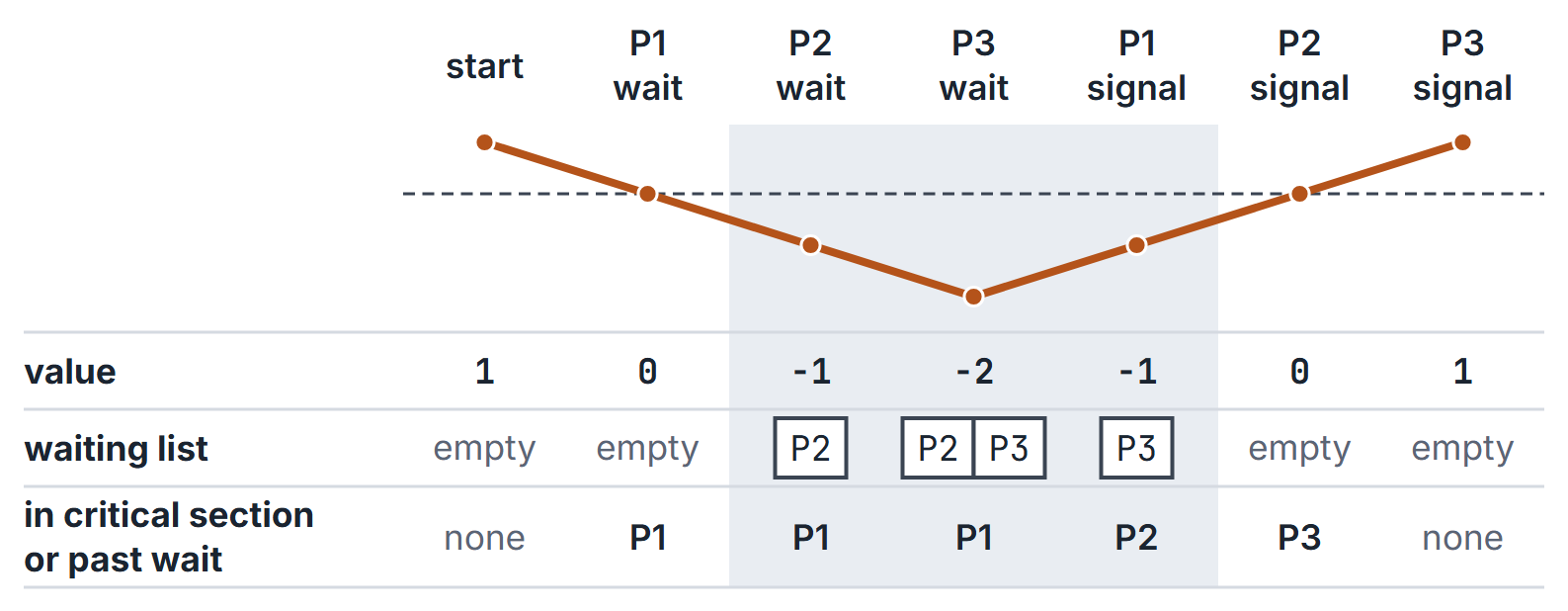
The semaphore of Figure 1 starts at 1. The six operations give:
| Operation | Value after | Waiting list |
|---|---|---|
| P1 wait | 0 | empty (P1 enters) |
| P2 wait | -1 | P2 |
| P3 wait | -2 | P2, P3 |
| P1 signal | -1 | P3 (P2 woken) |
| P2 signal | 0 | empty (P3 woken) |
| P3 signal | 1 | empty |
At every point, a negative value equals minus the number of waiting processes.
Counting operations
A counting semaphore starts at 10. Twelve wait and nine signal operations complete in some order. The final value is , and no process is left blocked.
Possible outputs
With :
X:  print "A"; signal(S); wait(T); print "C"
Y:  wait(S); print "B"; signal(T); print "D"
B cannot precede A (Y waits for S), and C cannot precede B (X waits for T, which Y signals after printing B). After signal(T), both C and D are free. The only outputs are ABCD and ABDC, and no interleaving deadlocks.
Lost updates with the wrong initial value
Three threads each run wait(S); x = x + 1; signal(S) with x = 0 and the increment done as a load and a store.
- With : the final value is always 3.
- With : the final value can be 1, 2 or 3. One way to get 1: A and B both load 0; B stores 1 and signals; C enters, loads 1, stores 2; A finally stores 1.
- With two threads, , and one thread omitting
waitandsignal, the counter can end at 1 or 2.
Mixed increments under a counting semaphore
and . Processes W and X each run wait(S); x = x + 1; signal(S); processes Y and Z each run wait(S); x = x - 2; signal(S). Each update is a load followed by a store. What values can end with?
With , two processes can be between wait and signal at once, so two updates can overlap and the later store can overwrite the earlier one. Searching by hand is error-prone, so enumerate every interleaving of the 16 steps (4 processes, each wait, load, store, signal). The reachable final values are exactly
The maximum 2 is reached when both decrements are overwritten: Y loads 0 and W loads 0; Y stores and signals; Z enters, loads ; W stores 1 (Y's update lost) and signals; X enters, loads 1; Z stores and signals; X stores 2 (Z's update lost). The minimum loses both increments symmetrically. With the semaphore is a mutex, every update is serialized, and the only result is .
A strict alternation puzzle
and :
P:  repeat 3 times: wait(S); print "0"; signal(T)
Q:  repeat 3 times: wait(T); print "1"; signal(S)
P can print only after a signal(S) and Q only after a signal(T). The semaphores pass a single token back and forth, so the only output is 010101. If starts at 2 instead, P may run one round ahead: the outputs are exactly 001011, 001101, 010011 and 010101, never three 0s in a row and never a 1 before the first 0. In general, the number of 0s printed minus the number of 1s printed always lies between 0 and the initial value of .
Deadlock from lock order
. P0 runs wait(S); wait(Q); ...; signal(Q); signal(S) and P1 runs wait(Q); wait(S); ...; signal(S); signal(Q). If P0 takes S and P1 takes Q, each blocks on the other's semaphore forever. If both take S first and then Q, no interleaving deadlocks. Ordering all locks globally is the standard prevention method, discussed in Deadlock.
Important properties and observations
waitandsignalmust themselves be atomic; kernels implement them with interrupt disabling (uniprocessor) or spinlocks (multiprocessor). The busy waiting moves into these short operations instead of disappearing.- A semaphore says nothing about which waiter is woken; a FIFO list gives bounded waiting, an arbitrary choice may starve a process.
- Deadlock and starvation are possible with correct semaphore code if the order of waits is wrong or the wake-up policy is unfair.
- Monitors prevent forgetting the lock but not deadlock between monitors or misuse of conditions.
Common misconceptions.
- "A semaphore's value is the number of waiting processes." Only its negative part is, and only in the blocking definition.
- "Binary semaphore and mutex are the same." A mutex has an owner.
- "
x.signal()increments something." A condition variable has no value.
GATE examination perspective
- Final value questions. for completed operations; check that the given order is possible at all (the busy-waiting form never goes below 0).
- Possible outputs and orderings. Build the precedence constraints from each
signalto thewaitit releases; enumerate the remaining freedom. - Initial values. 1 for mutual exclusion, 0 for ordering, for pools; check the initial value first; a wrong one breaks an otherwise correct scheme.
- Deadlock with semaphores. Two processes acquiring two semaphores in opposite orders can deadlock.
- Mutex versus binary semaphore; semaphore versus condition variable. Ownership, and remembered versus lost signals.
- Mesa semantics. Waiting must be in a
whileloop.
Summary
Sources
- A. Silberschatz, P. B. Galvin, G. Gagne, Operating System Concepts, 10th ed., Wiley: Chapter 6 (6.5 Mutex Locks, 6.6 Semaphores, 6.7 Monitors, 6.8 Liveness).
- A. S. Tanenbaum, H. Bos, Modern Operating Systems, 4th ed., Pearson: Sections 2.3.4 Sleep and Wakeup, 2.3.5 Semaphores, 2.3.6 Mutexes, 2.3.7 Monitors.