
Introduction
A network is useful only if its parts can reach each other, and it is robust only if it stays connected when something fails. Connectivity makes both ideas precise: whether paths exist between vertices, how a graph splits into connected pieces, and how many vertices or edges must be removed to disconnect it. These questions arise in network design (single points of failure), in algorithms (breadth-first and depth-first search find components, cut vertices and bridges in linear time) and in minimum spanning trees.
Prerequisites
- Graph Theory Fundamentals: degree, paths, cycles, trees, complements. Graphs are simple and undirected unless stated.
Core concepts
Connected graphs and components
- Vertices and are connected if there is a path between them. This is an equivalence relation on ; its classes are the connected components.
- is connected if it has exactly one component. The number of components is written or .
- The distance is the length of a shortest path. The eccentricity of is ; the diameter is the largest eccentricity and the radius the smallest. .
Edge counts and connectivity
For a simple graph with vertices:
| Statement | Bound |
|---|---|
| Connected needs at least | edges (a tree attains it) |
| With components, at least | edges |
| With components, at most | edges |
| A disconnected graph has at most | edges |
| So any graph with more than edges is | connected |
The maximum for components is attained by plus isolated vertices: concentrating vertices in one clique maximises edges, since for .
Degree condition. If , then is connected (two non-adjacent vertices have more than neighbours between them among the other vertices, so they share a neighbour). The bound is tight: two disjoint copies of have .
Cut vertices and bridges
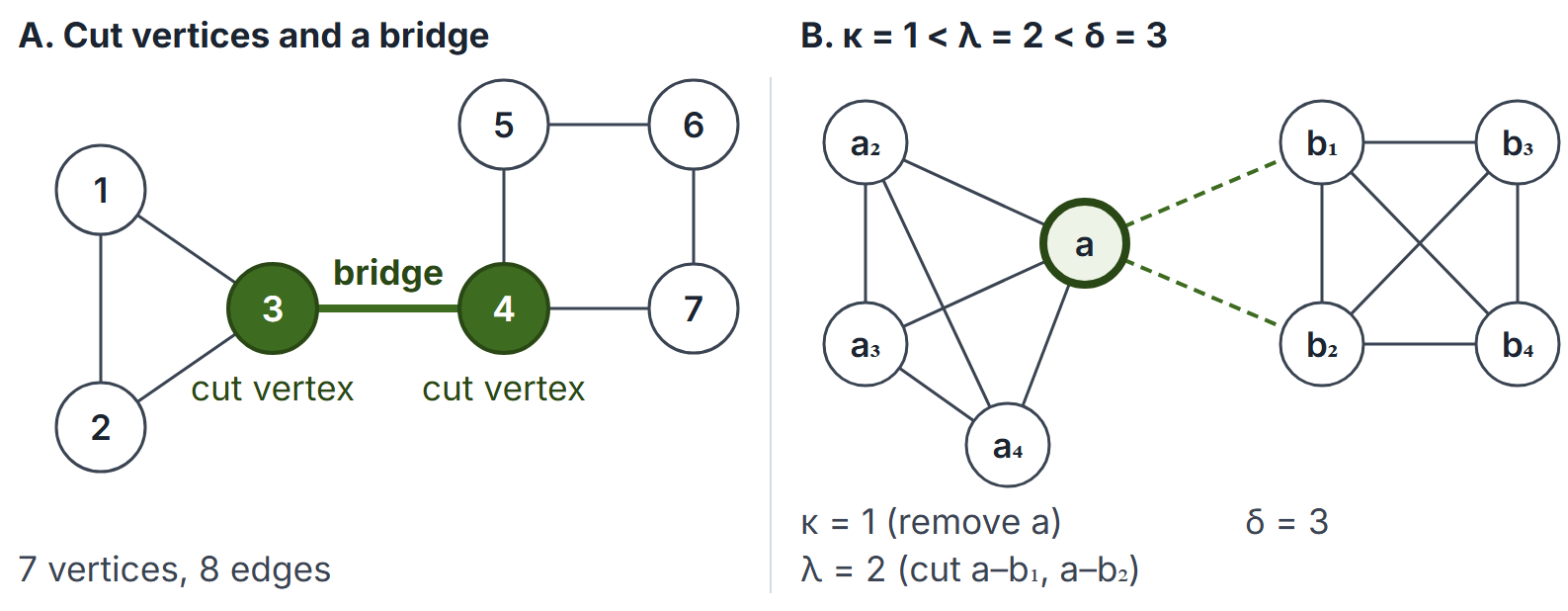
- A cut vertex (articulation point) is a vertex whose removal (with its incident edges) increases the number of components.
- A bridge (cut edge) is an edge whose removal increases the number of components.
- An edge is a bridge if and only if it lies on no cycle. Every edge of a tree is a bridge.
- A vertex is a cut vertex exactly when some distinct lie in the same component of , but are disconnected in ; equivalently a - path exists and every such path passes through .
- If is a bridge and , then is a cut vertex. The converse fails: a cut vertex need not be incident to any bridge (the shared vertex of two triangles joined at one vertex, the "bowtie").
- Every non-trivial connected graph has at least two vertices that are not cut vertices (the ends of a longest path).
A connected graph with no cut vertex (and at least 3 vertices) is 2-connected (biconnected). The maximal 2-connected pieces and bridges are its blocks. A graph with is 2-connected if and only if every two vertices lie on a common cycle (Whitney).
Vertex and edge connectivity
- The vertex connectivity is the minimum number of vertices whose removal disconnects or leaves a single vertex. by convention, since no set of vertices disconnects a complete graph.
- The edge connectivity of a graph with vertices is the minimum number of edges whose removal disconnects .
- is -connected if , and -edge-connected if .
- if and only if is disconnected (or trivial); if and only if is connected with a cut vertex (or ); if and only if is connected with a bridge.
Whitney's inequality:
The right inequality holds because removing all edges at a minimum-degree vertex isolates it. Both inequalities can be strict.
| Graph | |||
|---|---|---|---|
| 2 | 2 | 2 | |
| Tree with | 1 | 1 | 1 |
| , | |||
| Two sharing one vertex | 1 | 3 | 3 |
Menger's theorem (stated for reference): for non-adjacent , the minimum number of vertices separating them equals the maximum number of internally vertex-disjoint - paths; the edge version is the same with edges. This links connectivity to network flows.
Directed graphs
- A digraph is strongly connected if every vertex can reach every other along directed paths, and weakly connected if its underlying undirected graph is connected.
- The strongly connected components (SCCs) partition the vertices; contracting each SCC to one vertex gives a directed acyclic graph (the condensation). SCCs are found in time (Kosaraju's or Tarjan's algorithm).
- A strongly connected digraph on vertices has at least arcs (a directed cycle attains it).
Counting spanning trees
A spanning tree of a connected graph is a spanning subgraph that is a tree; it has edges. Every connected graph has one.
- Cayley's formula: has spanning trees (equivalently, there are labelled trees on vertices).
- has spanning trees. has .
- Kirchhoff's matrix-tree theorem: the number of spanning trees equals any cofactor of the Laplacian , where is the diagonal degree matrix and the adjacency matrix (delete row and column , take the determinant).
Worked examples
Example 1: forced connectivity
What is the minimum number of edges that guarantees a simple graph on 10 vertices is connected? A disconnected graph has at most edges, so 37 edges guarantee connectivity.
Example 2: components and edges
A simple graph with 12 vertices has 3 components. Minimum edges: . Maximum: .
Example 3: forests
A forest with 20 vertices and 14 edges has components (each tree component has one fewer edge than vertices).
Example 4: matrix-tree theorem
For minus one edge (vertices 1, 2, 3, 4; edge missing), the Laplacian is
Deleting row 1 and column 1: . So it has 8 spanning trees, compared with for . (Check: the 16 trees of split evenly over its 6 edges with containing any given edge, leaving that avoid it.)
Important properties and observations
- Removing a cut vertex can create many components (the centre of a star creates ); removing a bridge creates exactly one more.
- A connected graph with vertices and edges is a tree; with edges it has exactly one cycle.
- or is connected; if is disconnected, has diameter at most 2.
- A 3-regular graph has .
- An Euler graph (all degrees even) has no bridges.
GATE examination perspective
- Edge-bound questions. Maximum edges with components, minimum edges to force connectivity: .
- Forest component counts. Components .
- Cut vertex and bridge identification. A bridge lies on no cycle; check whether removing a vertex separates two others.
- . Expect true or false statements; know a strict example.
- Spanning-tree counts. Cayley , , matrix-tree theorem for small graphs.
- Trap: a graph with edges need not be connected; it is a tree only if it is also connected (or acyclic).
Summary
Sources
- K. H. Rosen, Discrete Mathematics and Its Applications, 7th ed., McGraw-Hill, 2012: Sections 10.4 (Connectivity) and 11.4 (Spanning Trees).
- D. B. West, Introduction to Graph Theory, 2nd ed., Prentice Hall, 2001: Sections 2.2 (Spanning Trees and Enumeration), 4.1 (Cuts and Connectivity) and 4.2 (k-connected Graphs).