
Introduction
The determinant is a single number attached to a square matrix. It tells whether the matrix is invertible (non-zero determinant), how the linear map scales area or volume, and, through the characteristic polynomial, what the eigenvalues are. The properties of determinants (effect of row operations, scaling, products, transposes, adjugates) give a faster route than a long expansion: simplify with row operations or apply a property.
Prerequisites
- Matrices and Matrix Operations: products, transposes, inverses, triangular and special matrices.
Core concepts
Definition and small cases
For , the determinant is
a sum over all permutations, each term taking one entry from every row and every column, with sign for even and for odd permutations. Small cases:
The diagonal (Sarrus) rule works only for matrices.
Minors, cofactors and expansion
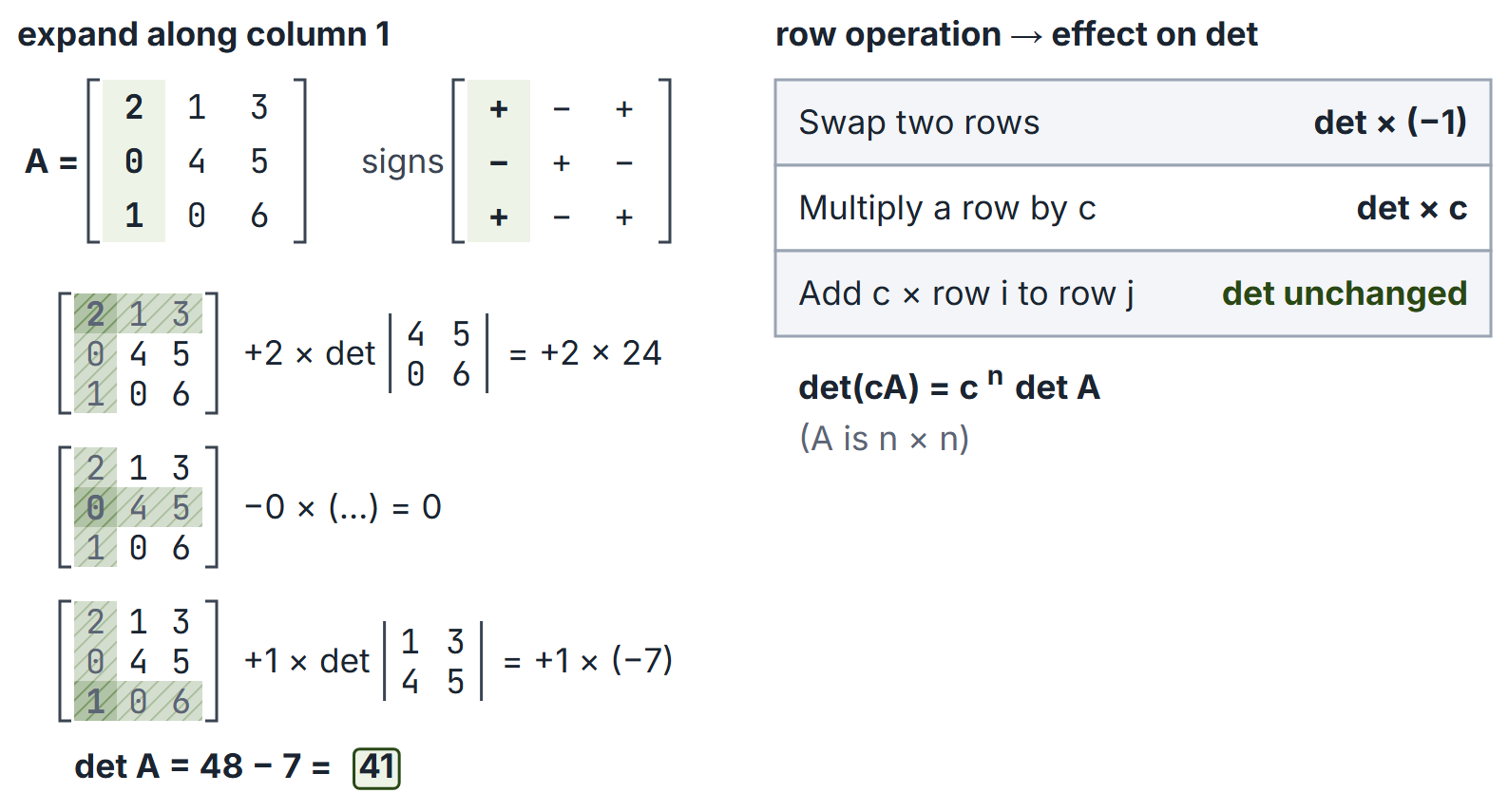
The minor is the determinant of the matrix left after deleting row and column . The cofactor is ; the signs form a chessboard starting with at the top left. Laplace (cofactor) expansion along any row or any column :
Expand along the row or column with the most zeros. Expanding along row with the cofactors of a different row gives 0: for (alien cofactors).
Properties
For matrices and scalar :
- . So every row property is also a column property.
- Row swap multiplies the determinant by .
- Scaling one row by multiplies the determinant by . Hence , not .
- Adding a multiple of one row to another leaves the determinant unchanged.
- Two equal rows, two proportional rows, or a zero row give . More generally, if and only if the rows (columns) are linearly dependent, if and only if is singular, if and only if .
- Triangular (and diagonal) matrices: .
- Multiplicative: , so and . There is no such rule for sums: in general.
- Linearity in one row: if row is , the determinant splits as the sum of the determinants with row equal to and to , other rows fixed.
- Block triangular: for square blocks .
- equals the product of the eigenvalues of , counted with algebraic multiplicity (see Eigenvalues and Eigenvectors).
Adjugate and inverse
The adjugate is the transpose of the cofactor matrix: . Combining expansion with alien cofactors gives
So when . Taking determinants, for :
Cramer's rule
If , the system has the unique solution , where is with column replaced by . It is useful for and systems and for proofs; for large systems elimination is far cheaper.
Geometry and computation
is the factor by which the linear map scales areas () or volumes (); the sign records whether orientation is preserved. The area of the parallelogram spanned by and is .
Computing from the permutation definition costs about operations; naive recursive cofactor expansion has factorial growth too (typically , versus for direct permutation evaluation). Row reduction to triangular form costs and is how determinants are computed in practice (see LU Decomposition).
Vandermonde determinant
and in general . It is non-zero exactly when the are distinct, which is why a polynomial of degree less than is fixed by its values at distinct points.
Worked examples
Example 1: choose the best line
. Along row 1: . Along column 1, which has a zero: .
Example 2: properties only
is with . Then , , , , and .
Example 3: dependent rows
, since . No expansion needed.
Example 4: a patterned matrix
. Add rows 2 and 3 to row 1: every entry of row 1 becomes ; factor it out to leave a row of 1s. Subtract column 1 from columns 2 and 3 to get a lower triangular matrix with diagonal . Result: . It vanishes at (all rows equal) and (rows sum to zero).
Example 5: Cramer's rule
, . ; ; . So , .
Example 6: odd skew-symmetric
For any skew-symmetric , , so .
Example 7: the general patterned matrix
The matrix with on the diagonal and everywhere else has
by the same steps as Example 4: add all rows to the first, factor out , then subtract. For , , : . The all-ones matrix () has determinant 0 for , and (, ) has .
Example 8: a tridiagonal recurrence
Let be the determinant of the tridiagonal matrix with diagonal entries , superdiagonal entries and subdiagonal entries . Expanding along the first row gives , with and . With , this is , so : and .
Example 9: products of rectangular matrices
is and is . Then is with rank at most 2, so always, while is and can be invertible. With and , has determinant 1 and . The rule is for square matrices only.
Important properties and observations
- Elementary row operations change the determinant in a predictable way: swap , scale , add a multiple .
- .
- An orthogonal matrix has ; an idempotent matrix has ; a nilpotent matrix has .
- Non-zero determinant is necessary and sufficient for invertibility of a square matrix; non-square matrices have no determinant.
- for square even when .
- A permutation matrix has determinant or (the sign of the permutation). Reversing the order of the rows takes swaps, so it multiplies the determinant by .
- The full expansion of an determinant has terms, which is why elimination () is used beyond .
GATE examination perspective
- Properties under scaling, transpose, product, inverse and adjugate: , .
- Evaluate quickly by row operations, factoring common terms, or spotting dependent rows.
- Link to eigenvalues: determinant = product of eigenvalues.
- Trap: writing or .
- Trap: using Sarrus's rule on a .
- Patterned and tridiagonal matrices. for constant diagonal and off-diagonal entries; for tridiagonal ones.
- Trap: applying to rectangular ; a product of a and a matrix is always singular.
Summary
Sources
- G. Strang, Introduction to Linear Algebra, 5th ed., Wellesley-Cambridge Press, 2016: Chapter 5 (Determinants), Sections 5.1 to 5.3.
- E. Kreyszig, Advanced Engineering Mathematics, 10th ed., Wiley, 2011: Chapter 7 (Linear Algebra: Matrices, Vectors, Determinants. Linear Systems).