
Introduction
Mensuration is the measurement of lengths, areas and volumes; the geometry it needs is a short list of facts about angles, triangles, circles and polygons. A figure or a description is given, and the task is a length, an area, a volume or a ratio of two of these. A scaling or a "melt and recast" step turns the task into a ratio calculation.
The method does not change: draw the figure, mark what is known, choose the formula whose inputs are known (or one step away, such as a slant height from Pythagoras), and keep everything exact in and surds until the last line.
Prerequisites
- Ratios and Percentages: scaling and percentage change of areas and volumes.
- Square roots and Pythagorean triples such as , , , .
Core concepts
Angles, triangles and polygons
- Angles on a straight line sum to ; angles round a point to ; vertically opposite angles are equal.
- The angles of a triangle sum to ; an exterior angle equals the sum of the two opposite interior angles.
- Pythagoras. In a right triangle with legs and hypotenuse , .
- Triangle inequality. Each side is less than the sum of the other two.
- Polygons. An -sided convex polygon has interior angles summing to ; its exterior angles sum to . A regular polygon has each exterior angle .
- Similar triangles. Equal angles; corresponding sides in a ratio ; areas in the ratio .
- Circles. The angle in a semicircle is ; a tangent is perpendicular to the radius at the point of contact; equal chords subtend equal angles at the centre.
Plane figures
| Figure | Perimeter | Area |
|---|---|---|
| Rectangle | ||
| Square side | ; diagonal | |
| Triangle | sum of sides | base height |
| Triangle, sides (Heron) | ||
| Equilateral triangle side | ; height | |
| Parallelogram | base height | |
| Rhombus, diagonals | ||
| Trapezium, parallel sides , height | sum of sides | |
| Circle radius | ||
| Sector, angle degrees | arc plus |
Solids
| Solid | Volume | Surface area |
|---|---|---|
| Cuboid | ; space diagonal | |
| Cube edge | ; space diagonal | |
| Cylinder radius , height | curved ; total | |
| Cone radius , height , slant | curved ; total | |
| Sphere radius | ||
| Hemisphere radius | curved ; total | |
| Right prism | base area perpendicular height | base area base perimeter height |
| Pyramid | base area height | base area of the triangular faces |
Here “base” in an area formula means base area, not a length. Volume equals base area times perpendicular height for oblique prisms too; the displayed surface-area formula requires a right prism.
Exactness convention. Results are kept exact in and surds; decimals use and are rounded to two places. With , a radius divisible by 7 cancels a factor 7 and often simplifies arithmetic, but does not guarantee an integer answer. Check which value the question uses.
Coordinate geometry essentials
For points and : distance , midpoint , slope for ; a vertical line through distinct points has undefined slope. The area of the triangle with vertices is
Decision procedure
- Draw and label. Mark every given length and angle; mark the unknown.
- Find a missing length first if a formula needs it: Pythagoras for a height or slant, the properties of special triangles, or similar triangles.
- Pick the formula whose inputs are now all known. For a composite figure, add and subtract simple pieces.
- Scaling. If every length is multiplied by , perimeters scale by , areas by and volumes by .
- Melt and recast. Volume is conserved; surface area is not. Equate volumes and solve.
- Stay exact until the end, then compare with the options.
Mathematical explanation
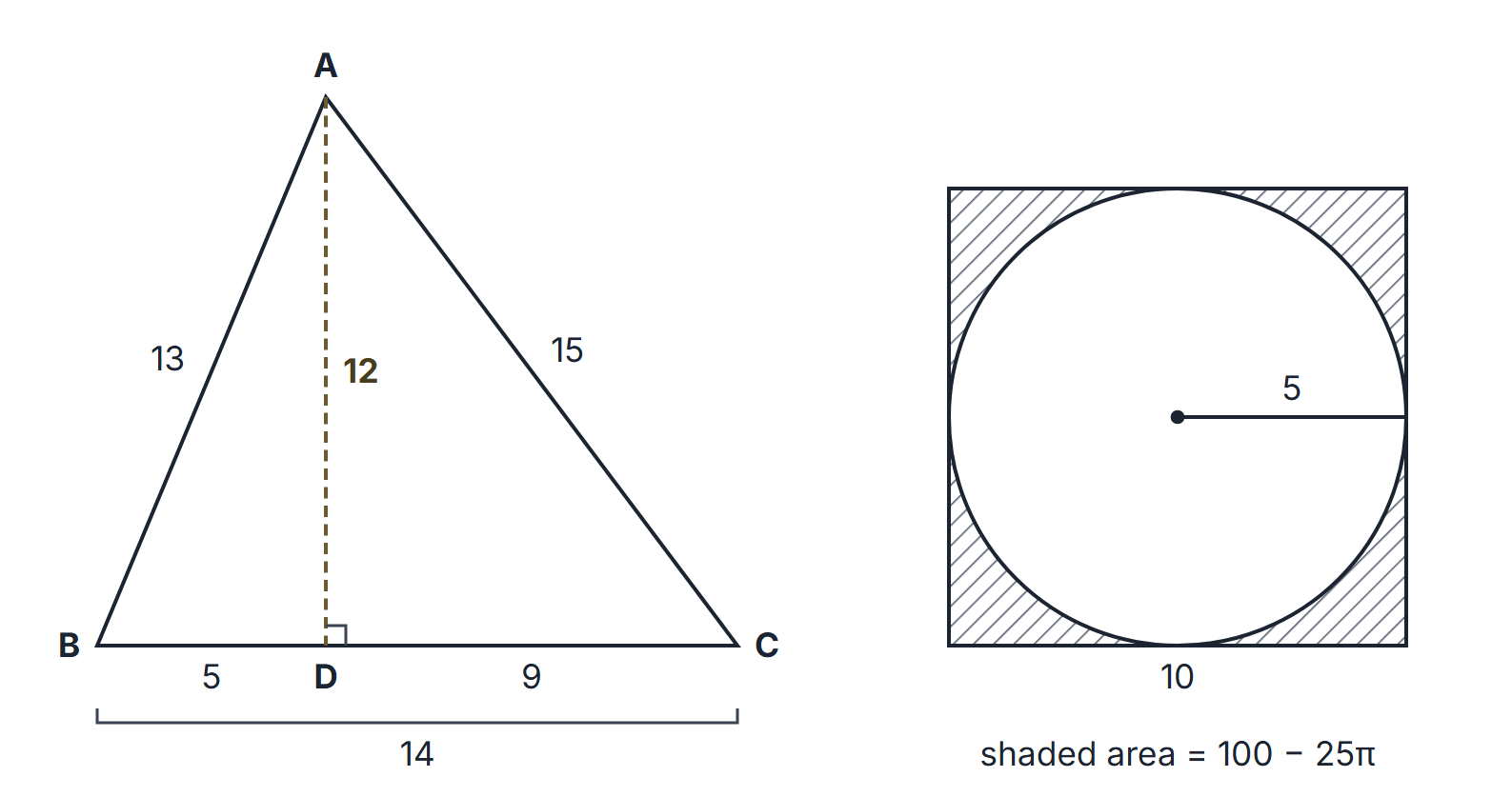
Heron's formula gives the area from the sides alone. For the 13, 14, 15 triangle, an independent route is the altitude: dropping the altitude to the side of 14 splits it into and with , so and ; then the area is , the same as Heron.
Scaling. Area is a sum of tiny squares, each of whose sides scales by , so each square scales by ; volume is a sum of tiny cubes, each scaling by . A 20% increase in every length () increases area by and volume by .
Cone and cylinder. A cone has one third of the volume of the cylinder with the same base and height; a sphere has two thirds of the volume of the cylinder that just encloses it (radius , height ).
Worked examples
Example 1 (Heron). Sides 13, 14, 15: , area . The altitude to the side of 14 is (Figure 1).
Example 2 (equilateral triangle). Side 6: area ; height .
Example 3 (sector). Radius 14, angle : area (exactly 154 with ); arc length (22 with ).
Example 4 (shaded region). A circle is inscribed in a square of side 10, so its radius is 5. The area inside the square but outside the circle is (Figure 1).
Example 5 (rhombus). Diagonals 10 and 24: area . The diagonals bisect each other at right angles, so the side is .
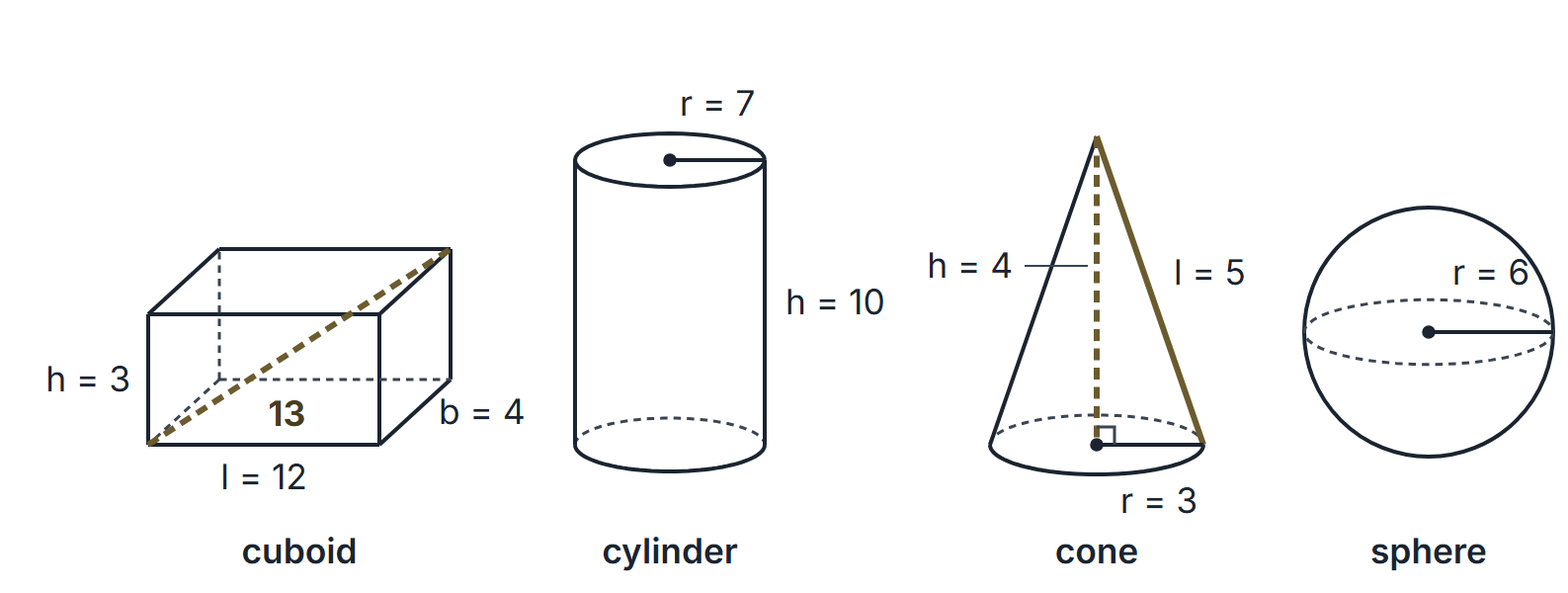
Example 6 (cuboid). : volume ; total surface area ; space diagonal .
Example 7 (cylinder). , : volume (1540 with ); curved surface .
Example 8 (cone). , : slant ; volume ; curved surface ; total surface .
Example 9 (melt and recast). A solid sphere of radius 6 is melted and recast into cones of radius 3 and height 4. Sphere volume: . Each cone: . Number of cones: .
Example 10 (scaling). Each edge of a cube grows by 20%. Volume grows by ; surface area by .
Example 11 (polygons). A regular octagon has each exterior angle , so each interior angle is . A regular polygon with interior angle has exterior angle , so it has sides.
Example 12 (similar triangles). Two similar triangles have corresponding sides in the ratio . Their areas are in the ratio . If the smaller has area 20, the larger has area .
Example 13 (coordinates). The triangle with vertices , , has area (base 4, height 3 agrees). The distance from to is .
Important properties and observations
- Common misconceptions. Doubling the radius doubles the area (it quadruples it). Melting preserves surface area (it preserves volume). The slant height of a cone is its height (it is ).
- Fixed perimeter. Among rectangles with a given perimeter, the square has the largest area; among all plane figures with a given perimeter, the circle has the largest area.
- Diameter versus radius. A given diameter must be halved before it is used as a radius.
- Units. Areas are in square units and volumes in cubic units; convert lengths before computing (1 m = 100 cm, so ).
- EDGE CASE. Three lengths form a triangle only if each is less than the sum of the other two; does not.
- Related material. A frustum of a cone with radii and height has volume ; it is the large cone minus the small cone cut off the top.
GATE examination perspective
- Composite-area questions. Shaded regions are differences of standard areas (Example 4).
- Hidden right triangles. Rhombus sides, cone slants and cuboid diagonals all come from Pythagoras (Examples 5, 6 and 8).
- Scaling traps. Options include , and changes; match the power to the dimension asked (Example 10).
- Recasting. Equate volumes; the count of pieces is a ratio of volumes, with cancelling (Example 9).
- conventions. Check whether options use or 3.14. A radius divisible by 7 often simplifies cancellation, not necessarily the answer to an integer; Examples 3 and 7 happen to give integers with .
- Polygon angles. Use exterior angles: per vertex of a regular polygon (Example 11).