
Introduction
The tasks are to say what a sheet looks like after it is folded, punched or cut and then opened, how many figures of a kind are hidden in a pattern, and how a flat net folds into a cube or how a painted cube looks after it is cut. The official syllabus phrase is "paper folding, cutting, and patterns in 2 and 3 dimensions".
To recover the holes after a sheet has been folded and punched, unfold in reverse order: a fold reflects one part of the sheet onto the other across the fold line, and unfolding reflects every hole back. For a cube net or a painted cube, the facts to use are which faces of a net end up opposite each other, and how many small cubes of an block have 0, 1, 2 or 3 painted faces.
Prerequisites
- Transformation of Shapes: reflection in a line, orientation.
- Sums of squares and choosing 2 items from , for figure counting (Permutations and Combinations, linked under Related topics).
Core concepts
| Idea | Rule |
|---|---|
| Fold | Reflects the moving part of the sheet across the fold line onto the fixed part |
| Layers | Each fold doubles the number of layers (for folds that cover the whole remaining sheet) |
| Punch through layers | Makes holes when opened, one per layer |
| Unfold | Undo the folds in reverse order, reflecting every hole across each fold line in turn |
| Cut on a fold | A cut touching the fold line opens into a shape symmetric about that line |
| Cube net | Six squares joined edge to edge that fold into a cube; there are 11 distinct nets |
| Opposite faces in a net | In a straight row of faces, faces with exactly one face between them are opposite |
| Standard die | Opposite faces sum to 7 |
Sheet convention. Coordinates are measured from the bottom-left corner of the unfolded sheet, to the right and upwards. A hole is recorded by its centre.
Unfolding rule. For a fold along the vertical line , a hole at gets a partner at ; for a fold along , the partner is at ; for a fold along the diagonal , the partner is at .
Decision procedure
Folding and punching
- Record each fold: its line and which side moves.
- Find where the punch is on the folded packet, in coordinates of the original sheet.
- Unfold the last fold first: add the mirror image of every hole across that fold line.
- Repeat for each earlier fold. The number of holes doubles at each step (unless a hole lies exactly on a fold line).
- Compare with the options by position, not just by count.
Nets and dice
- To find the face opposite a given face in a net, look along a straight row or column through it: the face two steps away is opposite. If none, fold mentally around the face that touches both.
- To find opposite faces from views of a die: two faces seen together in one view are adjacent, never opposite. A face is opposite a given face only when the given face has been seen next to four distinct other faces; the sixth is then its opposite. Otherwise the opposite is not determined unless further information fixes it.
Counting figures in a pattern
- Fix a systematic order (by size, or by top-left corner).
- Count each size class separately and add.
- Use known totals for grids: squares in an grid, rectangles in an grid.
Mathematical explanation
Why holes double. After folds that each cover the whole packet, the packet has layers, and every layer is an image of the sheet under a different combination of the fold reflections. A punch through the packet goes through every layer once, so opening the sheet shows holes, placed at the images of the punch point under those reflections.
Painted cube. Paint the outside of an cube and cut it into unit cubes (). The 8 corner cubes have 3 painted faces; each of the 12 edges carries cubes with 2 painted faces; each of the 6 faces carries cubes with 1 painted face; the inner cubes are unpainted. These four counts add up to .
Opposite faces. When a straight strip of three faces is folded, the first and third faces are both folded up by on opposite sides of the middle face, so they end parallel, facing each other: opposite faces of the cube.
Worked examples
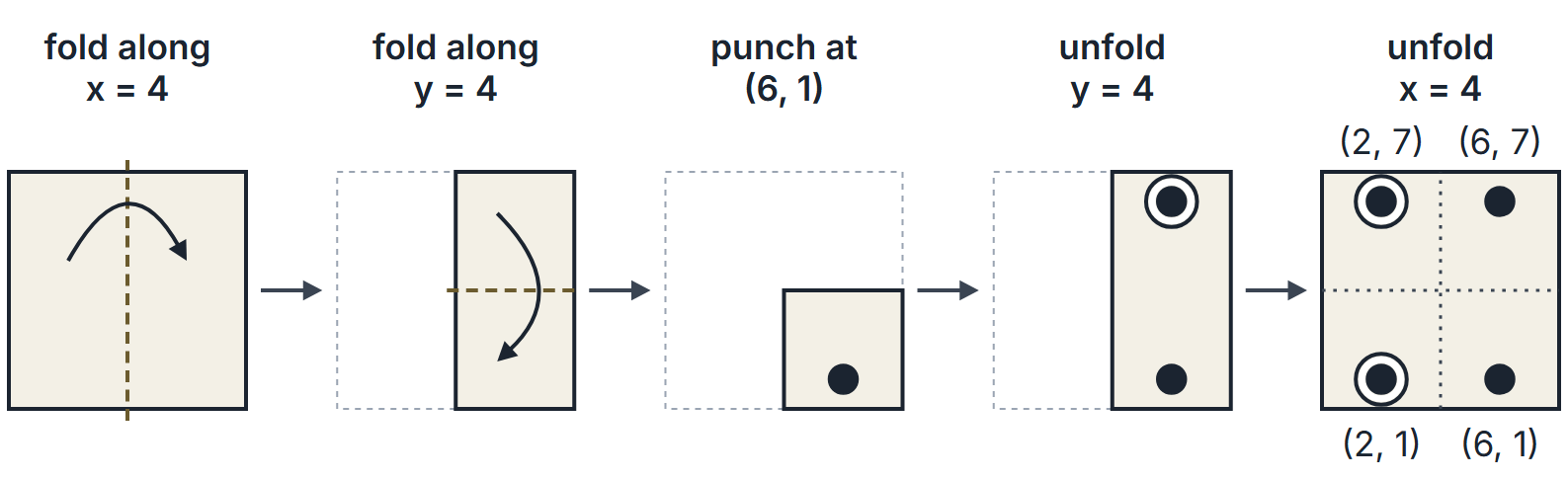
Example 1 (fold, punch, unfold). An square sheet is folded in half by bringing the left half onto the right half (fold line ), then folded again by bringing the top half onto the bottom half (fold line ). A hole is punched at .
- Unfold the second fold (across ): gains the partner .
- Unfold the first fold (across ): each hole gains a partner, and .
- Result: 4 holes at , , , , symmetric about both fold lines (Figure 1).
Example 2 (three folds). A sheet folded in half three times and punched once shows holes when opened.
Example 3 (diagonal fold). A square sheet with corners and is folded along the diagonal and punched at . On opening, the holes are at and .
Example 4 (cut on the fold). A sheet is folded once along a vertical line, and a semicircular notch of radius 2 is cut with its straight edge on the fold. On opening, the hole is a full circle of radius 2 centred on the fold line, with area .
Example 5 (counting squares and rectangles). A grid of unit squares contains squares, and rectangles (squares included): a rectangle is fixed by choosing 2 of the 5 vertical lines and 2 of the 5 horizontal lines.
Example 6 (counting triangles). An equilateral triangle of side 3 is divided into 9 small equilateral triangles of side 1 by lines parallel to its sides. Upward triangles: 6 of side 1, 3 of side 2, 1 of side 3. Downward triangles: 3 of side 1. Total: .
Example 7 (painted cube). A painted cube is cut into 64 unit cubes. Three faces painted: 8. Two faces: . One face: . None: . Check: .
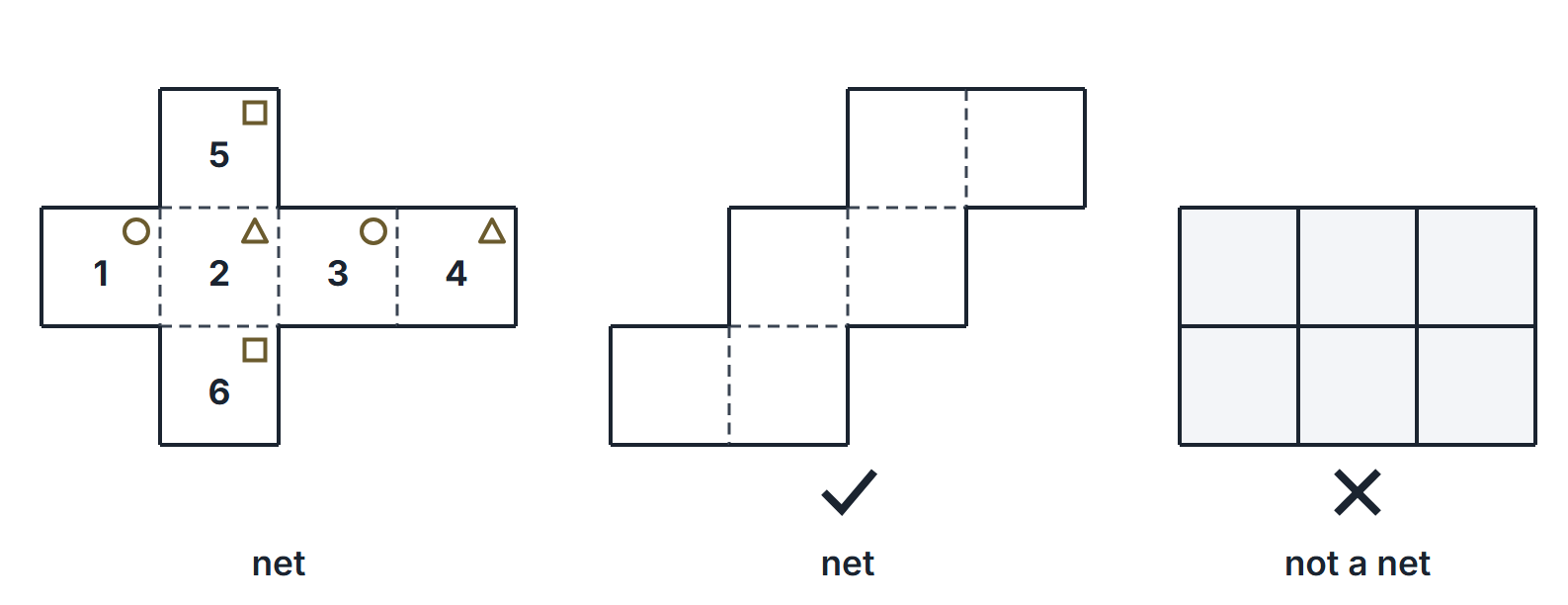
Example 8 (opposite faces in a net). In the cross-shaped net with faces 1, 2, 3, 4 in a row and faces 5 and 6 attached above and below face 2, the opposite pairs are 1 and 3, 2 and 4, 5 and 6 (Figure 2).
Example 9 (two views of a die). Two views of one die show the faces 1, 2, 3 and 1, 4, 5. Face 1 is seen next to 2, 3, 4 and 5, so these four are its neighbours, and the face opposite 1 must be 6.
Example 10 (not every hexomino is a net). A block of six squares is not a net: folding it leaves two faces on top of each other and one face of the cube uncovered. Of the 35 distinct ways to join six squares edge to edge, exactly 11 fold into a cube.
Example 11 (rolling a die). A die stands on a grid with 1 on top, 2 facing south and 3 facing east; opposite faces sum to 7. It is rolled one square north, then two squares east. Which face is on top?
- Roll north: the die tips over its north edge, so the south face (2) comes to the top and the top (1) goes to the north. Now top 2, bottom 5, east 3, west 4.
- Roll east: the west face (4) comes up. Top 4, bottom 3.
- Roll east again: the west face comes up. After the first east roll the west face is 5 (the bottom before that roll), so the top is now 5.
- Shortcut: two rolls in the same direction are a half turn, which swaps top and bottom. Before the two east rolls the top was 2 and the bottom 5, which gives 5 again.
- Trap: tracking only the top face loses information. Keep at least top, one side and the rolling direction, or use the half-turn shortcut.
Example 12 (opposite faces from three views). Three views of one die show the corner faces , and .
- Face 1 appears with 2, 3, 4 and 5, so 1 is opposite 6.
- Face 2 appears with 1, 3, 4 and 6, so 2 is opposite 5.
- Face 3 is seen next to only 1 and 2, so the four-neighbour test does not name 3's opposite. Once 1 is opposite 6 and 2 is opposite 5, the remaining pair is 3 and 4; they never appear together, which is consistent.
- Rule: two faces seen together in one view are adjacent, never opposite. A face is opposite a given face only when the given face has been seen next to four distinct other faces; the sixth is then its opposite. Otherwise the opposite is not determined unless further information (here, the two pairs already found) fixes it.
Example 13 (squares and rectangles in a rectangular grid). A grid of unit squares contains squares (sizes 1, 2 and 3), and rectangles. A square of side fits in positions.
Example 14 (triangles with lines from a vertex). In triangle ABC, two lines are drawn from A to points P and Q on BC, so four lines leave A (AB, AP, AQ, AC). Any two of them with the base BC make a triangle: . A line parallel to BC crossing all four lines adds another triangles with that line as base. Total: 12. Count by choosing the pair of lines from A and the base line, rather than by eye.
Important properties and observations
- Common misconceptions. "Holes on the fold line double" (a hole centred on a fold line opens into one hole, possibly larger). "Any six joined squares fold into a cube" (only 11 shapes do; Example 10). "Faces that touch only at a corner in the net end up opposite" (in the cross net, faces 1 and 5 touch only at a corner and are adjacent on the cube).
- Unfolding check. Reconstruct holes by reflecting the current packet in the actual fold lines in reverse order. The final pattern need not be symmetric about every later crease in original-sheet coordinates. Use an extra global symmetry only after establishing it for that fold sequence, as for the commuting perpendicular centre folds in Example 1.
- Four in a row. In a straight row of four faces, the first and third are opposite, and so are the second and fourth.
- Dice convention. On a standard die the opposite faces sum to 7; use that sum only when the die is stated to be standard.
- EDGE CASE. A fold that does not cover the whole packet (for example folding only a corner) doubles only the layers it covers; track each region separately.
GATE examination perspective
- Fold-punch questions. Unfold in reverse order, one fold at a time, and check symmetry (Examples 1 to 3).
- Cut questions. A cut touching a fold opens into a symmetric shape centred on the fold (Example 4).
- Counting questions. Count by size and orientation; count the downward triangles separately (Examples 5 and 6).
- Painted-cube questions. Use the 8, , , split and check the total (Example 7).
- Net questions. In a straight row of the net, faces two apart are opposite (Example 8); for pairs not in a straight row, as in the staircase net of Figure 2, fold around one fixed face (Example 10).
- Dice questions. Two faces seen together in one view are adjacent, never opposite. A face is opposite a given face only when the given face has been seen next to four distinct other faces; the sixth is then its opposite (Example 9). Otherwise the opposite is not determined unless further information fixes it (Example 12).
- Rolling dice. Track top and one side, or use the half-turn shortcut for two rolls in one direction (Example 11).
- Several views of a die. Two faces seen together are adjacent, never opposite; a face seen next to four distinct other faces is opposite the sixth (Examples 9 and 12).
- Counting figures. Count by size or by choosing lines, never by eye (Examples 5, 6, 13 and 14).
Summary
Sources
- D. Kirk et al., Contemporary Mathematics, OpenStax, 2023: Section 10.5 Tessellations (reflections and symmetry); Section 10.7 Volume and Surface Area (cubes and their faces). (consulted 2026-11-11).
- GATE 2027 General Aptitude syllabus, IIT Madras, Section 4 "paper folding, cutting, and patterns in 2 and 3 dimensions". (consulted 2026-11-11).