
Introduction
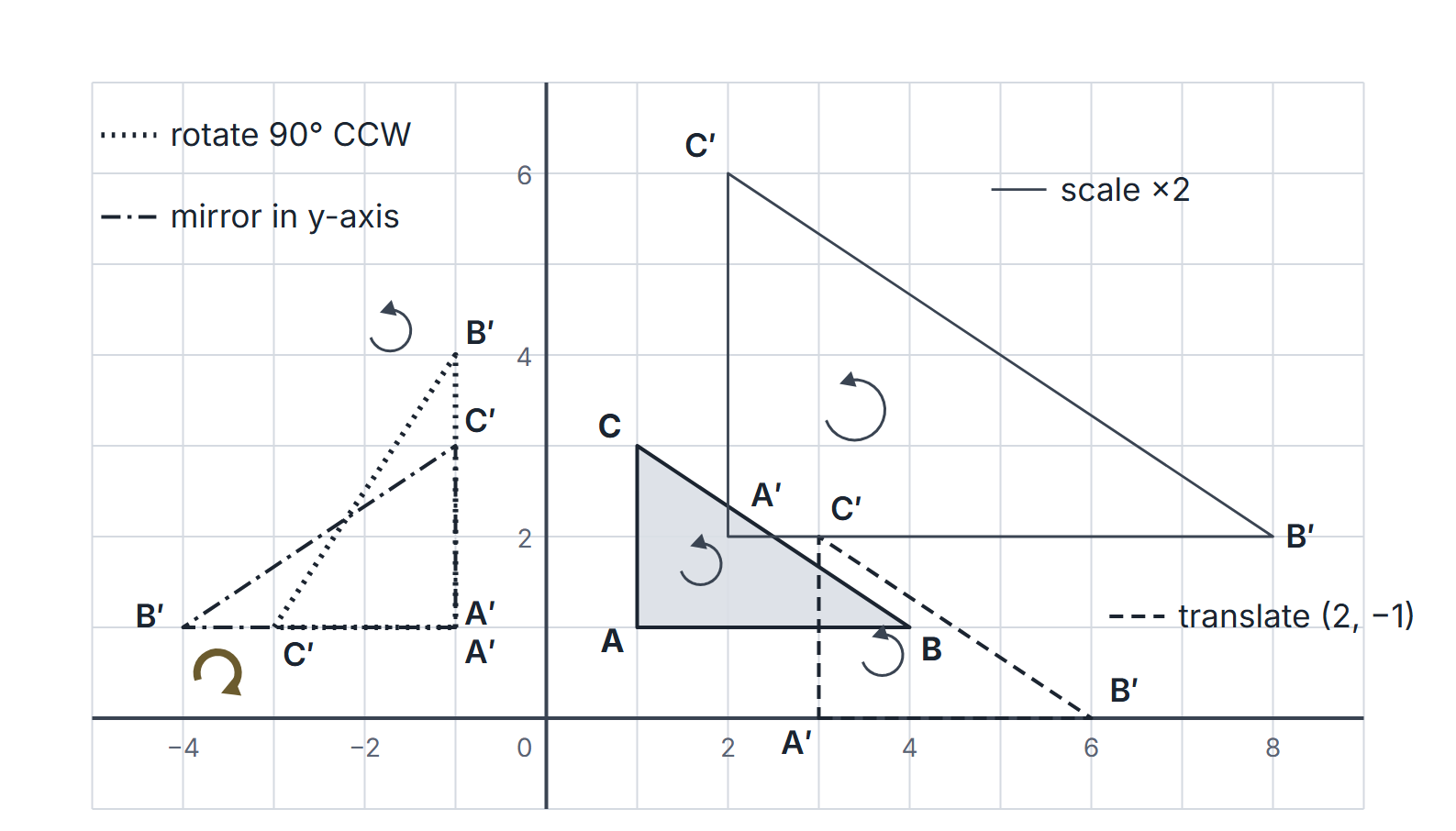
A figure may be translated, rotated, flipped or resized, or several figures may be the same shape in different positions. The official syllabus lists translation, rotation, scaling, mirroring, assembling and grouping. All of them can be done reliably in two ways: by imagining the motion, which is fast but error-prone, and by tracking a few labelled points with coordinates, which is slower but certain. Use the first and check with the second.
Orientation is the test: translations and rotations keep the cyclic order of labelled corners (clockwise stays clockwise), while a reflection reverses it. That test separates a piece that has been turned from its mirror image.
Prerequisites
- Points in the coordinate plane; distance and area of a triangle from coordinates (see Mensuration and Geometry).
- Angles measured in degrees; clockwise and counterclockwise.
Core concepts
| Transformation | What it does | Rule on a point | Lengths | Orientation |
|---|---|---|---|---|
| Translation by | Slides every point the same way | Kept | Kept | |
| Rotation counterclockwise about the origin | Turns a quarter turn left | Kept | Kept | |
| Rotation about the origin | Half turn | Kept | Kept | |
| Rotation clockwise about the origin | Quarter turn right | Kept | Kept | |
| Reflection in the -axis (vertical mirror) | Swaps left and right | Kept | Reversed | |
| Reflection in the -axis (horizontal mirror, "water image") | Swaps top and bottom | Kept | Reversed | |
| Reflection in the line | Swaps the coordinates | Kept | Reversed | |
| Scaling by about the origin | Enlarges or shrinks | Multiplied by | Kept |
Rigid motions. Translations, rotations and reflections (and their combinations) keep every length and angle, so the image is congruent to the original. Scaling keeps angles and multiplies lengths by and areas by , so the image is similar.
Orientation test. List three labelled corners of the original and of the image. Compute the sign of
For three non-collinear corresponding labelled points, positive means runs counterclockwise and negative means clockwise. Equal nonzero signs mean orientation is preserved; opposite signs mean orientation is reversed. Only after congruence (length preservation) is established does preserved orientation identify a rotation or translation rather than, for example, positive scaling.
Rotation about another centre. To rotate about a point , translate to the origin, rotate, and translate back.
Composition facts. Two reflections in parallel mirrors a distance apart make a translation by perpendicular to them. Two reflections in mirrors meeting at angle make a rotation by about the meeting point. A rotation followed by a reflection reverses orientation once. For a nonidentity rotation (angle not 0 modulo 360 degrees), it is a reflection when the centre lies on the mirror, and a glide reflection otherwise. An identity rotation followed by a reflection is just that reflection.
Decision procedure
- Identify the motion from the question: slide, turn (by how much, which way, about which point), flip (in which line), resize.
- Pick two or three distinctive features: a corner with a dot, the short side, the direction an arrow points.
- Move those features only, using the rules in the table or by turning the page in your head.
- Check orientation when the options include mirror images: rotations keep it, reflections reverse it.
- For grouping or odd-one-out: compare each figure with one reference figure by rotating it into the same position; the one that will not match without a flip is the mirror image.
- For assembling: check that the pieces' areas add up to the target, then match edges with equal lengths and corners with equal angles.
Mathematical explanation
Why rotation by is . A point at distance from the origin at angle is . Adding gives .
Why reflection reverses orientation. The orientation expression above changes sign when is replaced by throughout (one factor in each product changes sign), and is unchanged under (both products are transformed into each other with the same overall sign). This is why turning a figure can never produce its mirror image in the plane.
Scaling and area. Under the orientation expression, which is twice the signed area of triangle , is multiplied by .
Mirror clocks. In a vertical mirror the clock hands at angle from 12 appear at . A time of hours minutes therefore appears as the time that adds with it to 12:00: the mirror image of 3:40 shows 8:20.
Worked examples
Use the triangle , , , which has area 3 and orientation value (counterclockwise).
Example 1 (translation). By : , , . Same shape, same orientation.
Example 2 (rotation about the origin). counterclockwise, : , , . Orientation value still 6.
Example 3 (reflection). In the -axis, : , , . Orientation value : the labels now run clockwise.
Example 4 (scaling). By 2 about the origin: , , . Sides double; area goes from 3 to 12.
Example 5 (rotation about another point). Rotate by counterclockwise about . Relative to , is at ; rotating gives ; adding back gives .
Example 6 (two reflections). Reflect the point in the line , giving , then in the line , giving . The mirrors are 3 apart, and the net effect is a translation by to the right, for every point.
Example 7 (mirror clock). A clock reads 3:40. In a vertical mirror it appears to read .
Example 8 (mirror letters). In a vertical mirror, the capital letters A, H, I, M, O, T, U, V, W, X and Y look unchanged (each has a vertical line of symmetry). A word made only of these letters appears in the mirror as the same letters in reverse order: TOMATO appears as OTAMOT.
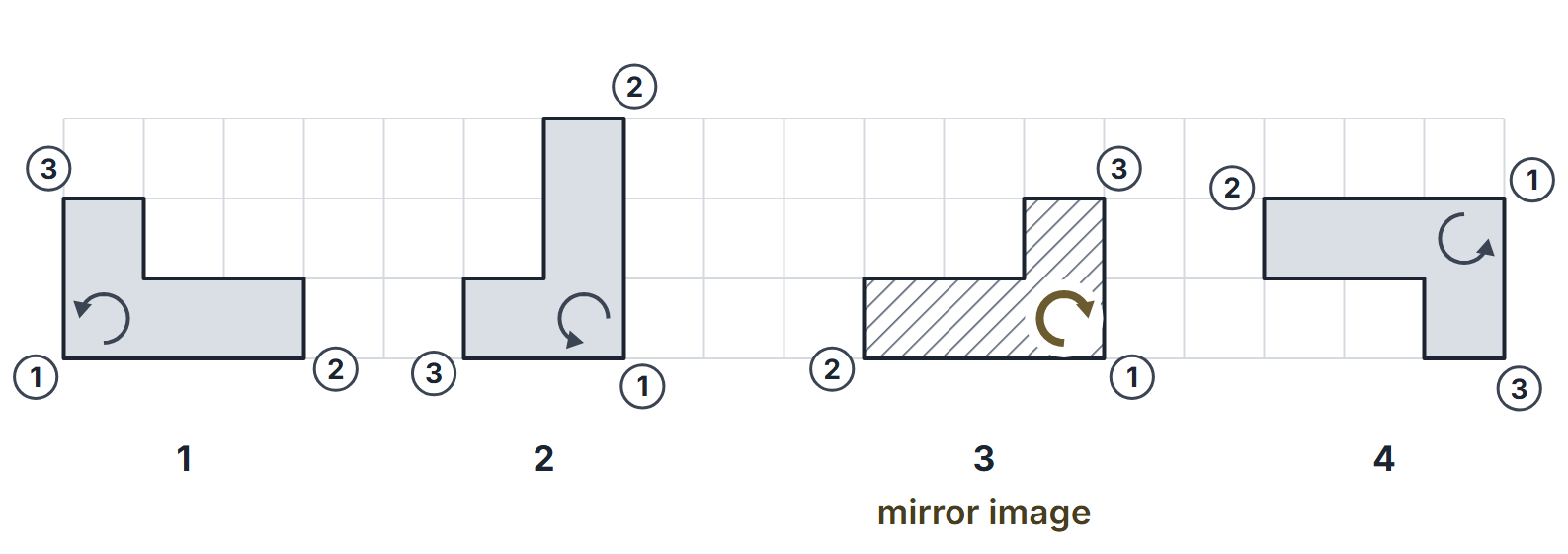
Example 9 (grouping and odd one out). Four L-shaped pieces are drawn with corners labelled in order 1, 2, 3 (corner of the L, end of the long arm, end of the short arm). Pieces 1, 2 and 4 have 1, 2, 3 counterclockwise; piece 3 has them clockwise. Pieces 1, 2 and 4 are rotations of one another; piece 3 is the mirror image and is the odd one out (Figure 2).
Example 10 (rotational symmetry). The order of rotational symmetry (the number of positions in a full turn where the figure looks the same) is 4 for a square, 3 for an equilateral triangle, 2 for a non-square rectangle and 6 for a regular hexagon. The letters N, S and Z have order 2 and no line of symmetry.
Example 11 (rotation sequence). An arrow points north and turns clockwise at each step. After 7 steps it has turned clockwise, so it points north-west; after 8 steps it is back to north.
Example 12 (water image). A water image is a reflection in a horizontal line below the object: when the water line is the -axis. Left and right are kept; up and down swap. An arrow from to (pointing up and to the right) has water image from to , pointing down and to the right. For a written word, a water image keeps the letters in their order but turns each one upside down, while a vertical mirror keeps each letter upright but reverses the order (Example 8). The orientation test still works: the triangle of Example 1 has orientation value 6, and its water image , , has .
Example 13 (rotating a grid pattern). A grid has shaded cells at (row, column) , and , with row 1 at the top. After a clockwise rotation, the cell moves to : the shaded cells become , and . A counterclockwise rotation would instead give , and ; comparing the two lists is how the options for "rotated clockwise" and "rotated counterclockwise" are told apart.
Example 14 (mirror versus rotation of a grid). Reflecting the same pattern in the vertical centre line sends to : , , . This set is not a rotation of the original: the original's two adjacent shaded cells and the lone cell form a shape whose mirror image, like the L-pieces of Example 9, cannot be reached by turning.
Example 15 (assembling). Which three of the following pieces can form a square of area 36? (A) a rectangle (area 12); (B) a square (area 16); (C) a rectangle (area 8); (D) a rectangle (area 10). First check area: , while any trio that includes D has area 38, 30 or 34, none equal to 36, so D is out. The remaining three fit: place A as a strip along one side of the square; the leftover region is a rectangle, which is exactly B and C placed side by side (). Area first, then matching edge lengths, is the reliable order.
Important properties and observations
- Common misconceptions. "A rotation of is the same as a reflection" (it is the same as two reflections, so orientation is kept). "Mirror images can be obtained by turning the figure in the plane" (they cannot). "Scaling changes angles" (it does not).
- Water image versus mirror image. A vertical mirror swaps left and right; a water surface (horizontal mirror) swaps top and bottom. Applying both is a rotation.
- Inverse moves. The inverse of a counterclockwise rotation is a clockwise rotation; a reflection is its own inverse.
- Assembling. Pieces can only form a figure if their areas sum to its area; then match the longest edges first.
- EDGE CASE. A shape with a line of symmetry is its own mirror image, so the orientation test cannot separate "rotated" from "reflected" for it; for such a shape both "rotated" and "reflected" can be correct, so the orientation test alone does not decide.
GATE examination perspective
- Direction-of-rotation traps. clockwise and counterclockwise give different images; check one corner with the coordinate rule (Examples 2 and 11).
- Mirror versus water image. Read which mirror is meant (Examples 3 and 7).
- Odd-one-out by orientation. Check each figure against a reference by rotation; a copy that matches only after a flip is the reflected one (Example 9).
- Clock mirror questions. Subtract from 12:00 (Example 7).
- Scaling questions. Lengths scale by and areas by (Example 4).
- Combined moves. Two reflections give a translation or a rotation; reflections in sequence reverse orientation an odd or even number of times (Example 6).
- Water images. Reflect in a horizontal line: ; letter order is kept and each letter is turned upside down (Example 12).
- Grid rotations. Use the cell map for clockwise on an grid, and compare with the counterclockwise and mirror maps (Examples 13 and 14).
Summary
Sources
- D. Kirk et al., Contemporary Mathematics, OpenStax, 2023: Section 10.5 Tessellations (translations, rotations, reflections and glide reflections); Section 10.3 Triangles (similarity). (consulted 2026-11-11).
- GATE 2027 General Aptitude syllabus, IIT Madras, Section 4 "Transformation of shapes: translation, rotation, scaling, mirroring, assembling, and grouping". (consulted 2026-11-11).