
Introduction
A limit describes what approaches as approaches a point, without caring what happens at the point itself. Continuity, derivatives and definite integrals are all defined through limits, and in computer science limits compare growth rates of running times. The tasks are to evaluate a limit (including an indeterminate form), decide whether a limit exists from one-sided behaviour, or pick a constant that makes a limit take a given value.
Prerequisites
None within this subject. Algebra, the graphs of the elementary functions, and the derivatives of , , , and are assumed.
Core concepts
Definition
Let be defined on an open interval around , except possibly at . Then means
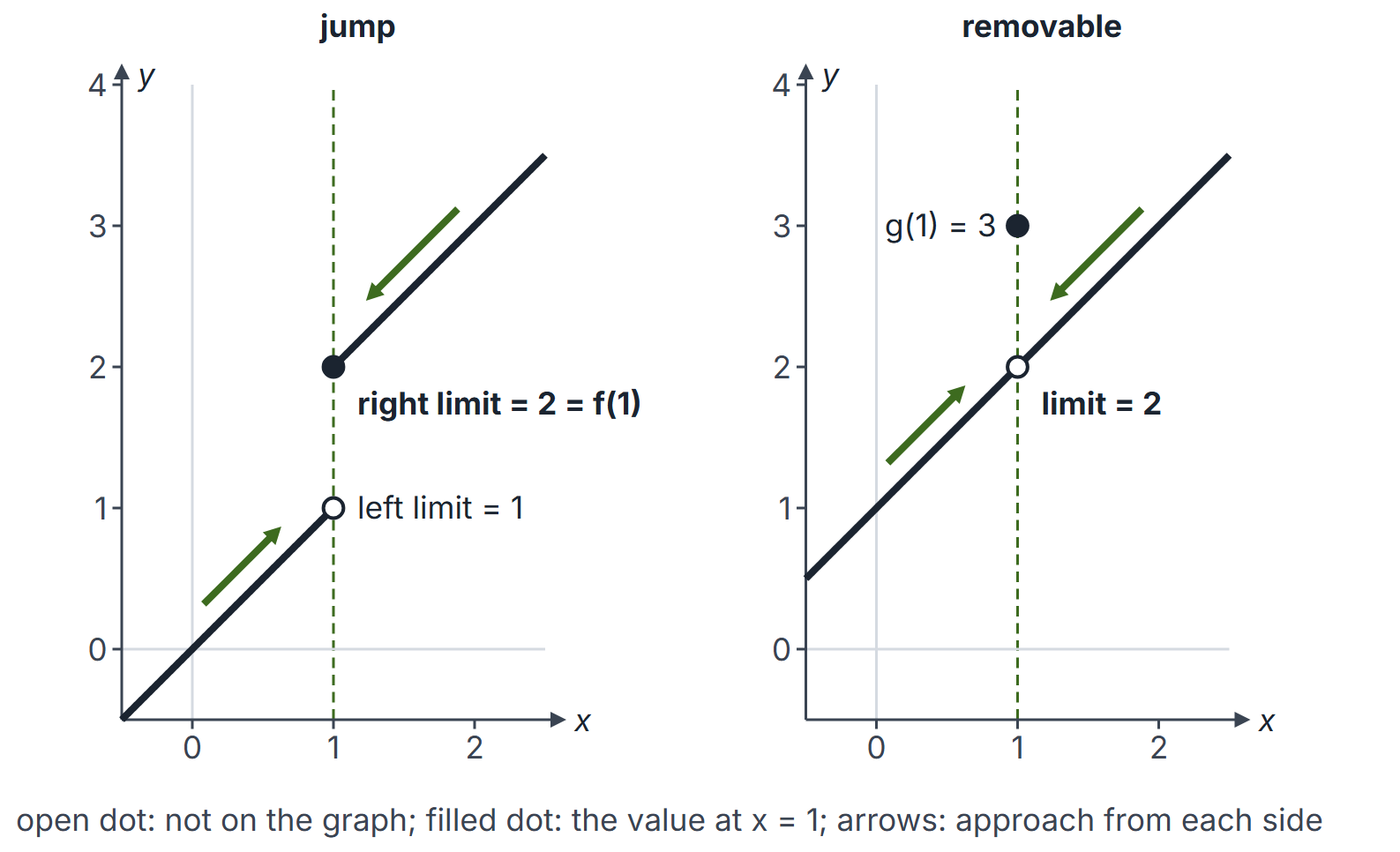
The condition excludes : the value , or whether is defined at all, has no effect on the limit. A limit, when it exists, is unique.
Variants use the same pattern. means for all sufficiently large . means exceeds any bound once is close enough to ; such a limit "does not exist" as a real number, but the notation records how it fails.
Limit versus value. and are different objects. They agree exactly when is continuous at , which is the subject of Continuity and Differentiability.
One-sided limits
The left limit uses only ; the right limit uses only . The two-sided limit exists if and only if both one-sided limits exist and are equal. Piecewise definitions, , and at 0 call for one-sided limits.
Limit laws
If and (both finite, same approach ), then the limits of , and are , and , and provided . If is continuous at , then ; this is what lets you move a limit inside , or .
Squeeze theorem. If near and , then . Standard use: , so as , although itself has no limit there.
Standard limits
As :
| Limit | Value |
|---|---|
| , | 1 ( in radians) |
| , | 1 |
| () | |
Also and .
Indeterminate forms
When the limit laws give , , , , , or , the answer depends on how fast each part moves, and more work is needed. The tools, roughly in order of preference:
- Algebra: factor and cancel, rationalise with a conjugate, divide by the highest power of .
- Standard limits (the Standard limits table), after rewriting.
- Series expansions of the standard functions.
- L'Hôpital's rule.
For the three exponent forms, write and find the limit of , which is a form.
L'Hôpital's rule
Suppose and are differentiable near (except possibly at ), near , and is of the form or at . If exists (finite, or ), then equals it. The same holds for one-sided limits and for .
The rule differentiates numerator and denominator separately; it is not the quotient rule. It only works in one direction: if does not exist, nothing follows about (Example 9).
The shortcut
If and , then
because when is near 1. For instance .
Series expansions near 0
As , expand numerator and denominator far enough to expose their leading nonzero powers and coefficients. Equal powers give the ratio of coefficients; a higher numerator power gives 0. A lower numerator power requires checking one-sided signs: the result may be , , or no two-sided limit.
Growth rates at infinity
As , for any constants and :
So . A rational function behaves like the ratio of its leading terms: . These facts are the limit form of the comparisons in Asymptotic Notation: if then ; if the ratio tends to a positive constant then .
Worked examples
Example 1: a standard trigonometric limit
.
Example 2: half-angle
, so .
Example 3: a form
. Similarly .
Example 4: L'Hôpital twice, or a series
is . L'Hôpital gives , still ; once more gives . With the series: the numerator is , so the ratio tends to .
Example 5: and
, an form; L'Hôpital gives . Hence .
Example 6: one-sided limits disagree
equals for and for . The left limit at 0 is , the right limit is , so does not exist.
Example 7: by a conjugate
Example 8: a cubic-order cancellation
: the numerator is , so the limit is . L'Hôpital three times gives the same: .
Example 9: where L'Hôpital is silent
, since . The ratio of derivatives, , oscillates between 0 and 2 and has no limit, so the rule's hypothesis fails and it says nothing; the limit still exists.
Example 10: choosing a constant
For which does exist (finite)? The numerator is . The term must vanish, so , and then the limit is .
Important properties and observations
- Changing at the single point never changes .
- can exist when neither nor does: .
- If while , then has no finite limit; check the sign on each side to decide between , and "does not exist".
- If near and both limits exist, then (strict inequality is not preserved: for , yet ).
- Degrees decide rational limits at infinity: equal degrees give the ratio of leading coefficients, a larger numerator degree gives , a larger denominator degree gives 0.
GATE examination perspective
- Evaluate a limit of an indeterminate form using standard limits, a series or L'Hôpital.
- and other exponent forms through or .
- Existence from left and right limits of piecewise, absolute-value or floor functions.
- Find a constant that makes a limit finite or equal to a given value (Example 10).
- Growth-rate comparisons used in asymptotic analysis.
- Trap: applying L'Hôpital to a form that is not or , or using the quotient rule instead of separate derivatives.
- Trap: degrees instead of radians in .