
Introduction
The mean value theorems link the average rate of change of a function over an interval to its instantaneous rate at some interior point. They are the bridge between "the derivative is positive" and "the function increases", and they give quick error bounds. The working tasks are finding the point promised by Rolle's or Lagrange's theorem, checking whether a theorem applies to a given function, and drawing a consequence such as the number of real roots or a numerical bound.
Prerequisites
- Continuity and Differentiability: continuity on a closed interval, differentiability on an open one, the extreme value theorem.
Core concepts
Rolle's theorem
Let be
- continuous on ,
- differentiable on , and
- such that .
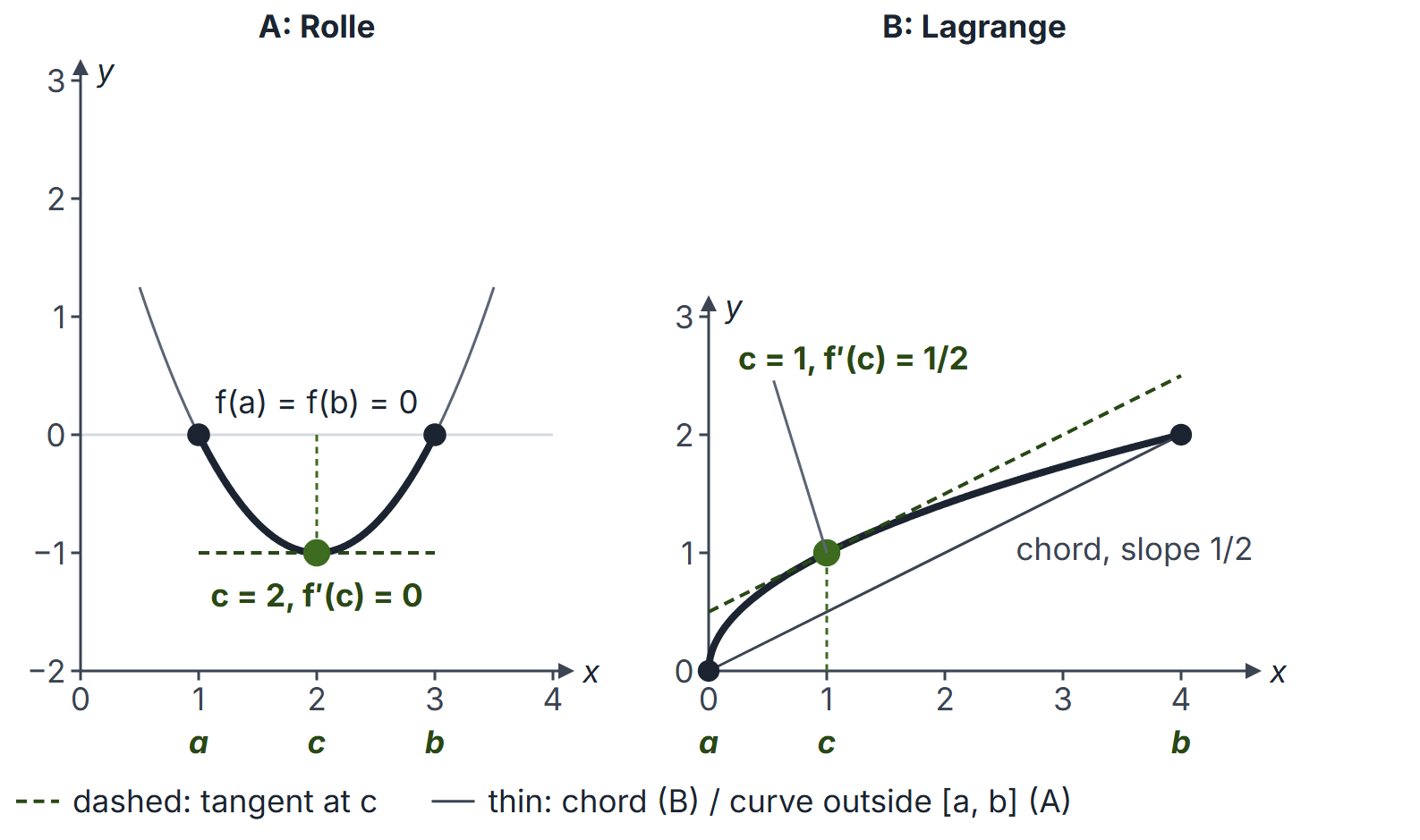
Then there is at least one with : somewhere the tangent is horizontal.
Why. By the extreme value theorem attains a maximum and a minimum on . If both occur at the endpoints, is constant and every works. Otherwise one occurs at an interior point, where Fermat's theorem gives .
Lagrange's mean value theorem
If is continuous on and differentiable on , there is with
Geometrically, some tangent is parallel to the chord joining and . Rolle's theorem is the special case . Proof: apply Rolle to minus the chord.
Equivalent forms. , and with : for some .
Cauchy's mean value theorem
If and are continuous on , differentiable on , and on , there is with
With this is Lagrange's theorem. Cauchy's version is the step used to prove l'Hôpital's rule.
Hypotheses matter
Closed versus open. Continuity is needed on the closed interval , differentiability only on the open interval . on qualifies even though does not exist.
If a hypothesis fails, the conclusion may fail:
- on : but is never 0 (not differentiable at 0).
- for and : but everywhere inside (discontinuous at 1).
- The theorems give existence only. Failure of a hypothesis does not forbid such a ; it just stops the guarantee.
Consequences
- on an interval is constant there.
- on an interval is constant.
- on an interval strictly increasing; strictly decreasing.
- If on , then .
- Between two roots of lies a root of . So if has no real roots, has at most one; in general, has at most one more real root than .
Taylor's theorem with remainder
The mean value theorem is the first case of Taylor's theorem: if has derivatives on an interval around , then
for some between and (Lagrange form of the remainder). With this is exactly Lagrange's theorem.
Worked examples
Example 1: Rolle's point
on : a polynomial, so continuous and differentiable; . gives .
Example 2: Lagrange's point and
on : chord slope ; gives .
For on any : gives , so is always the midpoint.
Example 3: a cubic
on : chord slope ; gives (the negative root lies outside the interval).
Example 4: Cauchy's point
, on : must equal , so .
Example 5: a numerical bound
Estimate . By Lagrange, with , so
Since , the left side exceeds , giving (true value ).
Example 6: counting real roots
: , so is strictly increasing and has at most one real root. , so by the intermediate value theorem it has exactly one, in .
Example 7: an identity from
For , has . So is constant, and .
Example 8: Taylor remainder bound
Approximate by . The remainder is with , so the error is at most . The actual error is about .
Example 9: which functions satisfy Rolle's hypotheses on ?
- : continuous, differentiable, . Yes, with .
- : and continuous, but does not exist. No guarantee (and indeed is never 0).
- : same failure at 0.
- : differentiable, but . Rolle does not apply; Lagrange does, with , (two valid points).
Example 10: an inequality
For any real , Lagrange gives , and , so . The same argument with on gives for , because lies between and 1.
Important properties and observations
- Rolle and Lagrange guarantee at least one ; there may be several ( on has two Rolle points, and ).
- For a quadratic , Lagrange's is always the midpoint .
- The point must be strictly inside ; discard roots outside it.
- The mean value theorem is what makes the first derivative test in Maxima and Minima valid.
- The intermediate value theorem (about values of ) and the mean value theorem (about values of ) are different; root-counting questions use both.
- Even when is not continuous, a derivative has the intermediate value property (Darboux's theorem), so a derivative cannot have a jump discontinuity.
GATE examination perspective
- Find for Rolle, Lagrange or Cauchy on a polynomial, root or exponential function.
- Check hypotheses: which of several functions satisfies Rolle's theorem on a given interval (watch for , and piecewise definitions).
- form questions: .
- Consequences: number of real roots, monotonicity, inequalities such as .
- Trap: reporting a root that lies outside .