
Introduction
A function is continuous where its graph has no break, and differentiable where the graph also has a well-defined tangent slope. Both are defined by limits, and the hypotheses of the mean value theorems, the tests for maxima and minima and the fundamental theorem of calculus are stated in these terms. The tasks are to check continuity or differentiability of a piecewise or absolute-value function at a point, find the constants that make a function smooth, count the points where a function fails to be differentiable, or test the "continuous but not differentiable" examples.
Prerequisites
- Limits: one-sided limits, limit laws, standard limits.
Core concepts
Continuity at a point
is continuous at if all three hold:
- is defined;
- exists (left and right limits exist and agree);
- .
Equivalently, for every there exists such that for every in the domain, . Right-continuity at uses only , and left-continuity only . is continuous on an open interval if it is continuous at every point, and on if in addition it is right-continuous at and left-continuous at .
Sums, differences, products and constant multiples of continuous functions are continuous; so is a quotient wherever the denominator is non-zero, and so is a composition when is continuous at and at . Polynomials, , , and are continuous everywhere; and on their domains; rational functions and wherever defined. is discontinuous at every integer (it is right-continuous there).
Kinds of discontinuity
| Kind | What happens at | Example |
|---|---|---|
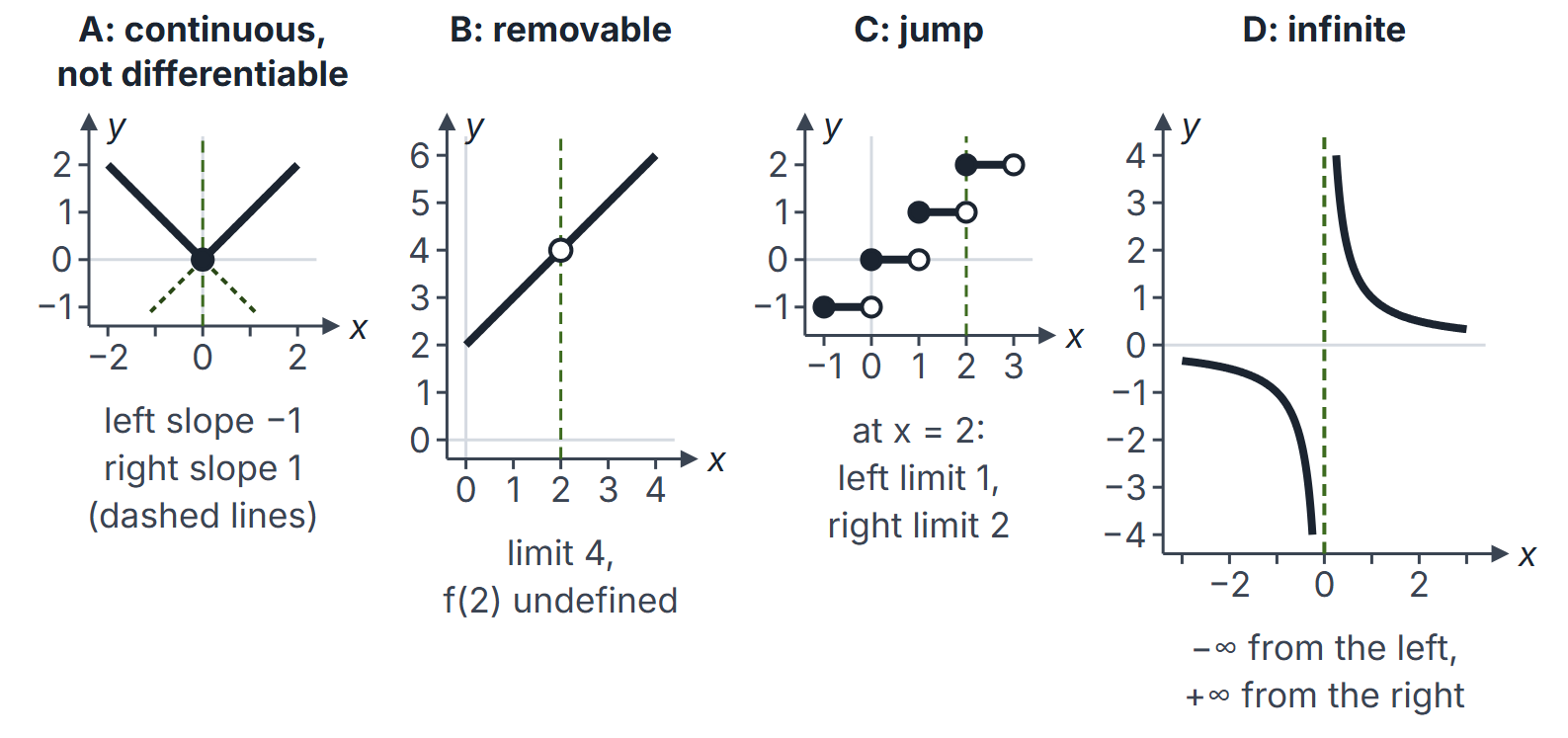
| Removable | the limit exists but is undefined or different from it | at 2 |
| Jump | left and right limits exist (finite) but differ | at an integer |
| Infinite | a one-sided limit is | at 0 |
| Oscillatory | a one-sided limit fails to exist without being infinite | at 0 |
A removable discontinuity is repaired by redefining as the limit; the others cannot be repaired.
Two theorems about continuous functions on
Intermediate value theorem (IVT). If is continuous on and lies between and , then for some . In particular, if and have opposite signs, has a root in ; this is the basis of the bisection method.
Extreme value theorem. If is continuous on the closed, bounded interval , it attains a maximum and a minimum value there. Both hypotheses matter: on is unbounded, and on has no maximum.
The derivative
is differentiable at if
exists (finite). Geometrically, is the slope of the tangent at . The left and right derivatives use and ; is differentiable at if and only if both exist and are equal.
Differentiable implies continuous. If exists, then . The converse fails, in three typical ways:
- Corner: at 0 has left derivative and right derivative .
- Vertical tangent: at 0 has difference quotient .
- Oscillation: (with value 0 at 0) has difference quotient , which has no limit.
Rules and standard derivatives
Linearity, product , quotient , and chain rule . For an inverse function, where and .
| , | |||
For differentiable real functions with , to differentiate , differentiate : . For example .
Derivative versus continuous derivative. A function can be differentiable everywhere while is not continuous. with has , yet for has no limit at 0.
Piecewise functions
At a junction point of a piecewise definition:
- continuity: the two pieces have the same value at (left limit = right limit = );
- differentiability: in addition, the left and right derivatives agree. When each piece is differentiable near and is continuous at , these one-sided derivatives can be read from the pieces' own derivative formulas evaluated at .
For with differentiable: at a simple root of (where , ) the graph has a corner; away from roots is differentiable. At a root where as well, is differentiable at (for example or ).
Worked examples
Example 1: a constant for continuity
for and . Since , is continuous at 0 exactly when .
Example 2: classify the discontinuities
- at 2: equals for , limit 4, undefined at 2: removable.
- at : left limit 1, right limit 2: jump.
- at 1: from the left, from the right: infinite.
- at 0: values sweep through in every neighbourhood: oscillatory.
Example 3: constants for differentiability
for , for . Continuity at 1: . Equal one-sided derivatives: . So , , and the line is the tangent to at .
Example 4: counting non-differentiable points
has slopes on , on and on . It is continuous everywhere and fails to be differentiable at exactly 2 points, and . Likewise has corners at its two simple roots 1 and 2.
Example 5: smooth once, not twice
: for and for . Both one-sided derivatives at 0 are 0, so for all , which is continuous. But has a corner at 0, so does not exist.
Example 6: a root by the IVT
has and , so a root lies in . Bisection: , so the root is in ; narrows it to . (The root is about 1.3247.)
Example 7: derivative from the definition
For , : , and , so . For , , the quotient is , which has no limit: is continuous at 0 (squeeze) but not differentiable there.
Example 8: chain rule and logarithmic differentiation
. . For (), gives , so and .
Important properties and observations
- Differentiable continuous limit exists; none of the reverse implications holds.
- A function can be continuous everywhere and differentiable nowhere (Weierstrass's function), so "continuous" says nothing about smoothness.
- At a corner, both one-sided derivatives exist but differ; at a vertical tangent or under oscillation, at least one fails to exist.
- The sum of a differentiable and a non-differentiable function is non-differentiable at that point, but two non-differentiable functions can sum to a differentiable one: .
- A continuous function on that is never zero keeps one sign there (IVT).
GATE examination perspective
- Continuity or differentiability at a point of a piecewise, absolute-value or floor function.
- Find constants that make a function continuous or differentiable (Examples 1 and 3).
- Count points of non-differentiability of sums of terms or of .
- Classic counterexamples: , , , .
- IVT to locate a root or decide whether an equation has a solution in an interval.
- Trap: concluding differentiability from continuity, or from equal one-sided limits of instead of .
- Trap: reading the one-sided derivatives from the piece formulas when is discontinuous at the junction; a discontinuous function is never differentiable there.
Summary
Sources
- G. Strang, Calculus, 3rd ed., Wellesley-Cambridge Press, 2017, Sections 2.1 (The Derivative of a Function), 2.5 (The Product and Quotient and Power Rules), 2.7 (Continuous Functions), 4.1 (The Chain Rule) and 4.3 (Inverse Functions and Their Derivatives). Free edition on MIT OpenCourseWare, (consulted 2026-11-11).