
Introduction
Finding the largest or smallest value of a function is a main use of the derivative. The method is short: locate the critical points, classify them with a derivative test, and, on a closed interval, compare with the endpoints. The tasks are to find the value or location of a maximum, the number of local extrema, whether a point is a maximum, minimum or neither, the inflection points, or the optimum of a small word problem.
Prerequisites
- Continuity and Differentiability: derivatives, the extreme value theorem, points where does not exist.
Core concepts
Local and global extrema
has a local maximum at if for all in some open interval around , and a global (absolute) maximum on a set if for all . Minima are defined with . A global extremum at an interior point is also a local one, but a global extremum on can sit at an endpoint, where the local definition (which needs an open interval) does not apply.
Critical points and Fermat's theorem
Fermat's theorem. If has a local extremum at an interior point and exists, then .
A critical point is an interior point of the domain where or does not exist. Every interior local extremum is a critical point, but not every critical point is an extremum: has and no extremum at 0.
First derivative test
Let be a critical point and continuous at .
- changes from to at : local maximum.
- changes from to : local minimum.
- keeps its sign: no extremum.
This test also works where does not exist ( at 0, at 0). Relatedly, on an interval makes strictly increasing there, and strictly decreasing (a consequence of the mean value theorem).
Second derivative test
If and exists:
- : local maximum;
- : local minimum;
- : no conclusion ( has a minimum, a maximum and neither, all with ).
Higher-order test. If and : for even , a minimum when and a maximum when it is negative; for odd , no extremum.
Sign convention. At a stationary point, gives a maximum (the graph bends down); picture .
Concavity and inflection points
is convex (concave up) on an interval if there ( is sufficient) and concave (concave down) if ( is sufficient). An inflection point is a point of the graph where the concavity changes. If exists there it must be 0, but is not enough: has and is convex on both sides. Check that changes sign.
Global extrema on a closed interval
For continuous on (so the extreme value theorem guarantees both extremes):
- find the critical points in ;
- evaluate at each critical point and at and ;
- the largest value is the global maximum, the smallest the global minimum.
No classification is needed. On an open or unbounded interval, also examine the limits at the ends, since the extremes may not be attained.
Functions of two variables
For a function on a neighbourhood of an interior stationary point, first solve . Then evaluate at that point. Boundary and nondifferentiable points require separate treatment:
- , : local maximum; , : local minimum;
- : saddle point (neither);
- : no conclusion.
Worked examples
Example 1: the figure's function
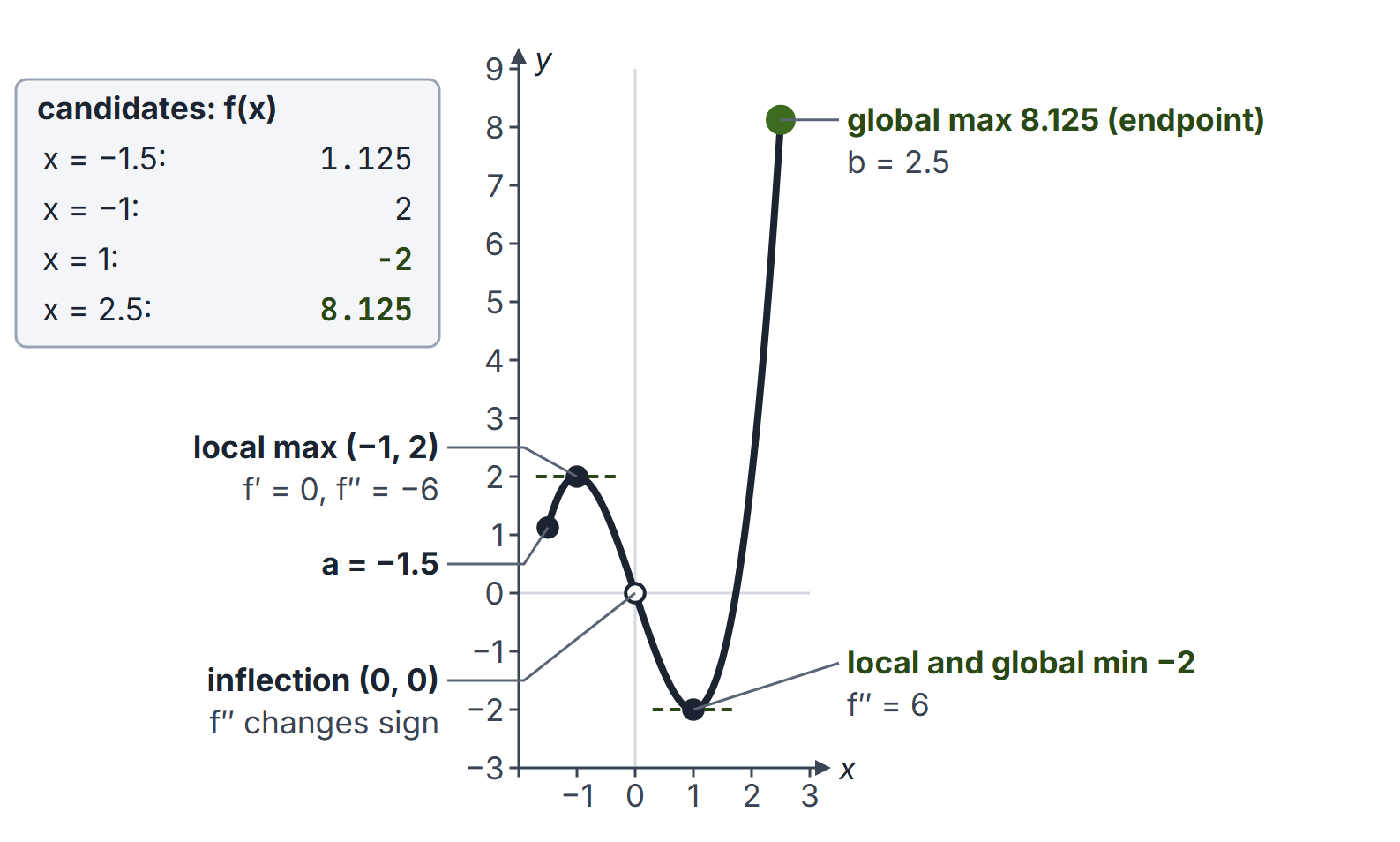
, , . Critical points : gives a local maximum ; gives a local minimum . changes sign at 0, an inflection point. On : and , so the global maximum is 8.125 (at the endpoint 2.5) and the global minimum is (at 1).
Example 2: a stationary point that is not an extremum
, , . At : , a local (in fact global) minimum . At : , and on both sides of 0, so there is no extremum. Inflection points where changes sign: and .
Example 3: counting extrema
: at ; . So is a local maximum () and a local minimum (): two local extrema, and no global ones on because .
Example 4: an open-box problem
Squares of side are cut from the corners of a sheet and the sides folded up. Volume for . gives in the domain. , so the maximum volume is .
Example 5: a critical point where does not exist
has , undefined at 0, negative for and positive for . By the first derivative test, 0 is a minimum (a cusp). The second derivative test cannot be applied.
Example 6: maximum on an unbounded interval
on : , positive before 1 and negative after. and as , so the global maximum is .
Example 7: a trigonometric maximum
: at (in also ). and . In general ranges over .
Example 8: two variables
: , , so the critical points are and . , , , so . At : and , a local minimum with value . At : , a saddle point.
Important properties and observations
- Between two local maxima of a continuous function there is always a local minimum (the smallest value of on the interval between them), so for a smooth function with finitely many critical points, local maxima and minima alternate.
- A continuous function with a single critical point on an interval, where that point is a local extremum, has a global extremum of the same kind there (Example 6).
- Monotone functions on take their extremes at the endpoints; no derivative is needed.
- For a quadratic , the vertex is at : a minimum if and a maximum if .
- A product with fixed sum is largest at (value ); a sum with fixed product () is smallest at .
GATE examination perspective
- Value or location of the maximum or minimum of a polynomial, exponential or trigonometric function, including on a closed interval.
- Count local extrema or inflection points.
- Classify a stationary point, including cases where the second derivative test is inconclusive.
- Small optimisation problems (box, fence, product with a fixed sum).
- Trap: forgetting the endpoints when the question asks for a global extremum on .
- Trap: treating as "inflection point" or "no extremum" without checking signs.