
Introduction
This part of Analytical Aptitude covers puzzles where the answer comes from combining several small facts about order, position or number: who sits where, who is older, how far and in which direction someone ends up, what the time or the day is, which statement about an inequality chain must hold, or which number satisfies a set of digit conditions. No single formula solves them. What solves them is a disciplined representation (a grid, a number line, a coordinate plane, an equation) and a rule for using the clues in the right order.
For each family the note gives that representation, the arithmetic facts it relies on (divisibility, HCF and LCM, clock and calendar rules), and worked examples.
Prerequisites
- Linear equations in one or two unknowns; ratios from Ratios and Percentages.
- Integer arithmetic and remainders.
Core concepts
| Puzzle family | Representation | Key rule |
|---|---|---|
| Linear arrangement | Row of numbered slots, with the facing direction stated | "Immediately right" means the adjacent slot on the right of the person, as they face |
| Ranking | Number line | Total rank from left rank from right |
| Inequality chains | Chain such as | A definite conclusion needs an unbroken chain in one direction |
| Ages | Equations in present ages | Every person ages by the same number of years |
| Directions | Coordinate plane, north as , east as | Final distance by Pythagoras, direction from the signs |
| Clocks | Angles in degrees | Minute hand per minute, hour hand per minute |
| Calendars | Day numbers modulo 7 | Odd days: extra days beyond whole weeks |
| Number properties | Divisibility, HCF, LCM, remainders | Events repeating every and units coincide every |
Direction convention. People in a row face north unless told otherwise, so their right is east (the higher slot number). Turning "right" from north means facing east.
Divisibility rules worth using. By 3 or 9: digit sum divisible by 3 or 9. By 4: last two digits divisible by 4. By 8: last three digits divisible by 8. By 11: alternating digit sum divisible by 11. And for positive integers .
Decision procedure for an arrangement puzzle
- Draw the frame: slots numbered left to right, the facing direction, and who is to be placed.
- Place fixed clues first: an exact position ("R is in the middle").
- Attach relative clues to placed people ("T is immediately right of R").
- Branch on the clue with fewest options ("Q is at an end": two cases), and write each case as its own row.
- Apply negative clues ("not at an end", "not adjacent") to eliminate cases.
- Stop when one case remains or the requested answer is invariant across all surviving cases, then re-check every clue and the queried fact.
Mathematical explanation
Ranking. If a person is -th from the left and -th from the right, there are people to the left and to the right, so the row has people.
Clock angle. With the hour reduced modulo 12, , and minutes the minute hand is at degrees from 12 and the hour hand at degrees. The angle between them is , replaced by minus that value if it exceeds . The hands coincide every minutes, which is 11 times in 12 hours.
Calendars. A 365-day interval shifts the weekday by one; a 366-day interval shifts it by two. For the same date next year, check whether the actual interval contains 29 February, rather than looking only at the named year. A Gregorian year is a leap year if divisible by 4, except century years, which must be divisible by 400.
Same remainder. For a positive divisor , if , and leave the same remainder, then divides both differences and . Provided the three integers are not all equal, the largest such divisor is . If all three are equal, every positive divisor works, so there is no largest one.
Worked examples
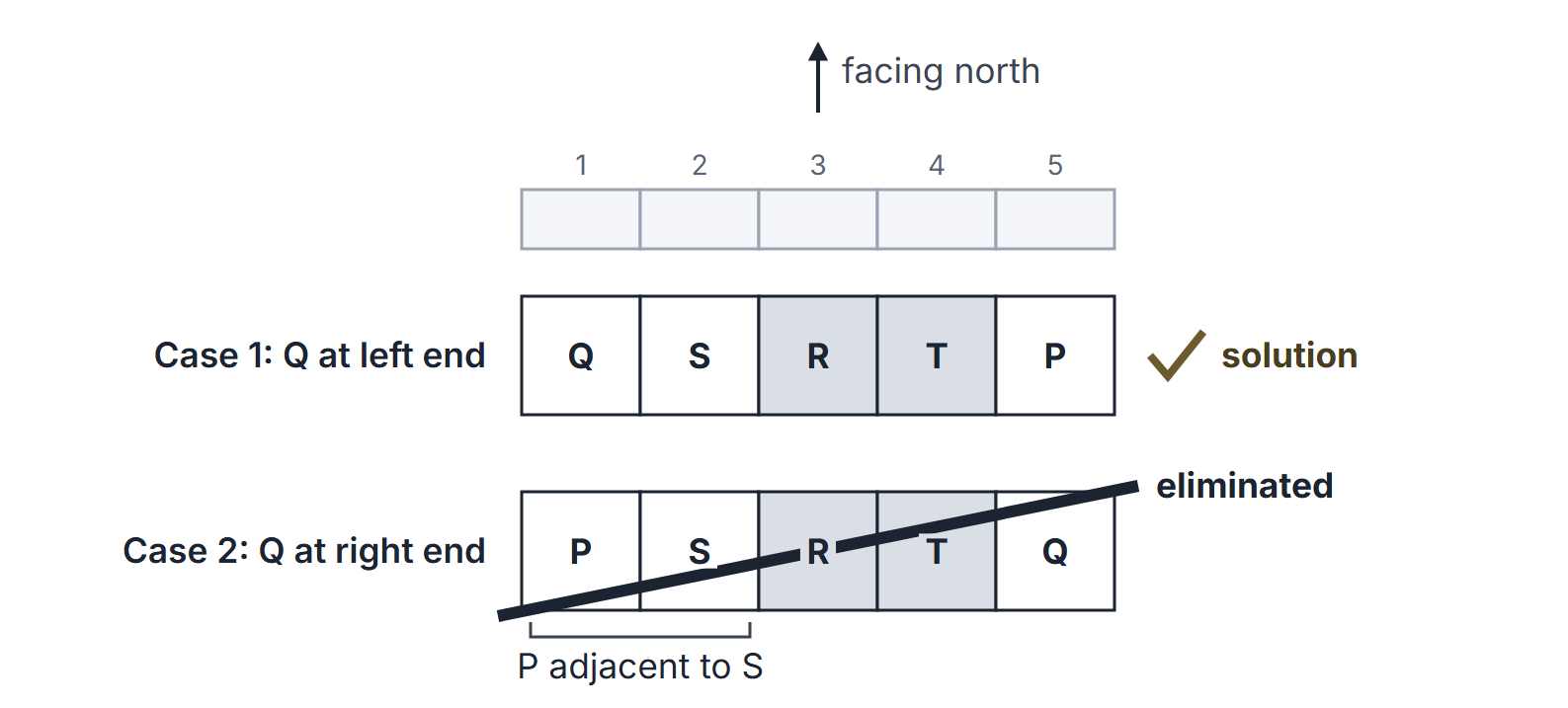
Example 1 (linear arrangement). P, Q, R, S and T sit in a row facing north. R sits in the middle. T sits immediately to the right of R. Q sits at one of the ends. S does not sit at an end. P is not adjacent to S. Find the order from left to right.
- R is in slot 3 and T in slot 4.
- Case 1: Q in slot 1. Slots 2 and 5 remain; S is not at an end, so S is in slot 2 and P in slot 5. P (slot 5) is not adjacent to S (slot 2): allowed.
- Case 2: Q in slot 5. Slots 1 and 2 remain; S takes slot 2 and P slot 1. P is adjacent to S: eliminated.
- Order: Q, S, R, T, P (Figure 1).
Example 2 (ranking). Ravi is 7th from the left and 12th from the right in a row. The row has people.
Example 3 (inequality chain). Given , , and :
- is definite ().
- is definite ().
- is not definite: may equal .
- Nothing relates and except through : , so is definite.
Example 4 (blood relations). A is B's full sister (they have the same parents). C is B's mother. D is C's father. Then C is A's mother too (A and B are siblings), so D is A's maternal grandfather, and A is D's granddaughter.
Example 5 (directions). A walker goes 5 km north, 6 km east, 2 km south and 2 km west. Coordinates: , , , . The distance from the start is km, towards the north-east (both coordinates positive).
Example 6 (clock). At 3:40 the angle is .
Example 7 (calendar). In a non-leap year that begins on a Monday, 1 March falls days after 1 January. , so 1 March is 3 weekdays after Monday: a Thursday.
Example 8 (ages). The ages of a father and son are in the ratio . In 10 years they will be in the ratio . With present ages and : , so , . The ages are 35 and 10.
Example 9 (LCM). Three bells ring every 6, 8 and 12 minutes and ring together at noon. They next ring together after minutes.
Example 10 (same remainder). The largest number that divides 70, 100 and 130 leaving the same remainder is the HCF of the differences 30 and 30, which is 30. The common remainder is .
Example 11 (digits). A two-digit number has digit sum 9, and reversing its digits increases it by 27. With digits (tens) and (units): and , so , giving , . The number is 36.
Example 12 (divisibility). The six-digit number is divisible by 9 exactly when its digit sum is a multiple of 9, so .
Example 13 (circular arrangement). Six friends A, B, C, D, E, F sit around a round table, evenly spaced, all facing the centre. A sits opposite D. B sits immediately to the left of A. E sits immediately to the right of D. C does not sit next to D. Who sits opposite C, and who is immediately to the right of F?
- Convention. Number the seats 0 to 5 counterclockwise as seen from above. A person facing the centre has seat on the right and seat on the left. Rotating everyone gives the same arrangement, so fix A at seat 0.
- A at 0, so D at 3 (opposite). B at 5 (left of A). E at 4 (right of D).
- Seats 1 and 2 remain for C and F. Seat 2 is next to D, so C is at 1 and F at 2.
- Opposite C (seat 1) is seat 4: E. Immediately right of F (seat 2) is seat 3: D.
- Trap: in a circle facing the centre, "left" and "right" are reversed compared with a row seen from the front; state the convention before placing anyone.
Example 14 (when the hands coincide). Between 4 and 5 o'clock, when are the hands together? The minute hand gains per minute on the hour hand, which starts ahead. They meet after minutes, at about 4:21:49. The tempting answer 4:20 forgets that the hour hand keeps moving.
Example 15 (same date, next year). 10 January 2025 was a Friday. A non-leap year has days, so 10 January 2026 is one weekday later: a Saturday. Leap-day trap: from 10 January 2027 (a Sunday) to 10 January 2028 there is no 29 February in between, so the shift is 1 day (Monday); but from 10 March 2027 (a Wednesday) to 10 March 2028 the span includes 29 February 2028, so the shift is 2 days (Friday).
Example 16 (relation in a sentence). Pointing to a man in a photograph, Ravi says, "He is the son of my grandfather's only son." If the grandfather is Ravi's father's father, his only son is Ravi's father, and the son of Ravi's father is Ravi or Ravi's brother; pointing to a photograph does not exclude Ravi himself. The man is uniquely Ravi's brother under this reading only if the question additionally states that he is not Ravi. If the grandfather were the mother's father, his only son would be Ravi's maternal uncle and the man Ravi's cousin. If the options contain both brother and cousin, the question is ambiguous; otherwise only one reading matches an option. Work from the far end of the chain ("my grandfather") inwards.
Example 17 (direction after turns). A person faces north, turns to the right, then to the left. Measure headings clockwise from north: , which is : north-west.
Important properties and observations
- Common misconceptions. "Immediately right" and "to the right" are different (adjacent versus anywhere on that side). People facing south have their right on the west. In a consistently directed chain, all non-strict links give only a non-strict conclusion; one strict link suffices for a strict end-to-end conclusion. Thus gives , but the local claim is not forced (Example 3).
- Ranking with ties or gaps. The formula assumes one person per position and no gaps.
- Ages. Differences of ages never change; ratios do.
- Clocks. The hands are at right angles 22 times in 12 hours and coincide 11 times; between 2 and 3 they coincide at minutes past 2.
- Calendars. Leap years add two weekdays; century years are leap years only if divisible by 400.
- EDGE CASE. If no case satisfies the clues, the premises are inconsistent. If several cases survive, evaluate the queried fact in all of them; "cannot be determined" is warranted only if that answer varies.
GATE examination perspective
- Arrangement puzzles. Even when only one fact from the final arrangement is needed, build the full case grid anyway, because a partial grid can mislead (Example 1).
- Facing-direction traps. Left and right depend on the facing direction stated in the question.
- Definite versus possible. In inequality chains, only an unbroken chain in one direction gives a definite answer (Example 3).
- Direction questions. Track coordinates, not turns in your head (Example 5).
- Clock and calendar questions. With the hour reduced modulo 12 and minutes in [0,60), use the formula and odd days modulo 7 (Examples 6 and 7).
- Number puzzles. Translate the words into one or two equations and check the result against every condition (Examples 8 and 11).
- Circular seating. Fix one person to remove rotations and state which way is left (Example 13).
- Clock coincidence. Divide the starting gap by per minute (Example 14).
- Calendars across a year. One extra weekday per normal year, two if the span includes 29 February (Example 15).
- Relations in one sentence. Resolve the chain from the far end inwards (Example 16).
- Turns. Add right turns and subtract left turns as headings (Example 17).