
Introduction
An argument gives premises and claims that a conclusion follows from them. Deduction claims that the conclusion follows necessarily: if the premises are true, the conclusion cannot be false. Induction claims only that the premises make the conclusion likely, as when a pattern seen in many cases is extended to the next one. Both appear in the material that follows: syllogisms ("All A are B; some B are C; which conclusions follow?"), conditional statements ("if", "only if", "unless"), and short arguments where the task is to find an assumption, an inference, or the statement that strengthens or weakens the reasoning.
A key habit is to separate what follows from what is true or plausible. A deductive conclusion is judged only against the premises, never against general knowledge; an inductive conclusion is judged by how well the evidence supports it.
Prerequisites
- Careful reading of quantifiers ("all", "some", "no", "only") and connectives ("if", "unless", "either ... or").
- Sets and Venn diagrams at the level of union, intersection and complement.
Core concepts
| Term | Meaning |
|---|---|
| Valid argument | The conclusion is true in every situation where all premises are true |
| Sound argument | Valid, with true premises |
| Strong inductive argument | True premises make the conclusion probable, but not certain |
| Counterexample | A situation where the premises hold and the conclusion fails; one is enough to show invalidity |
Categorical statements
| Form | Statement | Venn reading (S = subject, P = predicate) |
|---|---|---|
| A | All S are P | The part of S outside P is empty |
| E | No S is P | The overlap of S and P is empty |
| I | Some S are P | The overlap of S and P has at least one member |
| O | Some S are not P | The part of S outside P has at least one member |
Existence convention. Every class named in the premises is taken to be non-empty, unless a problem states otherwise. Under this convention "All S are P" implies "Some S are P", and "No S is P" implies "Some S are not P".
Contradictory pairs. A and O contradict each other ("All S are P" against "Some S are not P"), and so do E and I: exactly one of each pair is true. This is the basis of "either ... or" answers.
Conditional statements
For statements and , "if then " () is false only when is true and is false.
| Form | Equivalent to | Valid or not |
|---|---|---|
| Contrapositive: if not , then not | Equivalent | |
| Converse: if , then | not equivalent | Not implied |
| Inverse: if not , then not | not equivalent | Not implied |
| " only if " | is necessary for | |
| " if " | is sufficient for | |
| " unless " | Same as " or " |
Argument patterns. Modus ponens (, , so ) and modus tollens (, not , so not ) are valid. Affirming the consequent (, , so ) and denying the antecedent (, not , so not ) are fallacies.
Negating quantifiers. The negation of "All S are P" is "Some S are not P", not "No S is P". The negation of "Some S are P" is "No S is P".
Decision procedure
For a syllogism
- Draw one circle per class (three overlapping circles for three classes).
- Enter universal premises (A, E) first by shading the regions they say are empty.
- Enter particular premises (I, O) next by placing a mark in the region that must be non-empty. If the mark could lie in either of two unshaded regions, put it on the boundary: it is not known which. After shading, also place an existence witness for every class explicitly assumed nonempty, in an allowed region of that class; keep its position unresolved if several regions remain possible. This existential-import assumption is additional to modern logic, which permits empty classes. Follow the convention stated in the question; without a nonemptiness premise, universal statements alone do not supply witnesses.
- A conclusion follows only if the diagram forces it: a shaded region for A or E, a mark that lies wholly inside the region for I or O.
- If two conclusions form a contradictory pair (A and O, or E and I, about the same two classes) and neither follows, the answer is "either one or the other follows".
For a conditional or an argument
- Rewrite every sentence as (translate "only if", "unless", "no ... without").
- Check the pattern: ponens and tollens are valid; affirming the consequent and denying the antecedent are not.
- For an inductive argument, identify the evidence, the conclusion and the gap between them. An assumption fills the gap; a strengthener narrows it; a weakener offers another explanation or a counterexample.
Mathematical explanation
A syllogism about three classes has eight Venn regions. A "situation" is a choice of which regions are non-empty. A conclusion follows exactly when it holds in every situation that satisfies the premises and the existence convention. The Venn method is a compact way to see all those situations at once: shading removes situations, a forced mark keeps only those where a region is occupied, and an unresolved mark on a boundary records an "or".
Truth tables do the same for conditionals: and agree on all four rows, while and differ on two of them.
Worked examples
Example 1 (chain of universals). All dogs are mammals. All mammals are animals.
- "All dogs are animals" follows: Dogs lies inside Mammals, which lies inside Animals.
- "All animals are dogs" does not follow (it is the converse).
- "Some animals are dogs" follows under the existence convention, because dogs exist and every dog is an animal.
Example 2 (particular then universal). Some pens are blue. All blue things are costly.
- "Some pens are costly" follows: the pens that are blue are costly.
- "Some costly things are not pens" does not follow: every costly thing might be a pen.
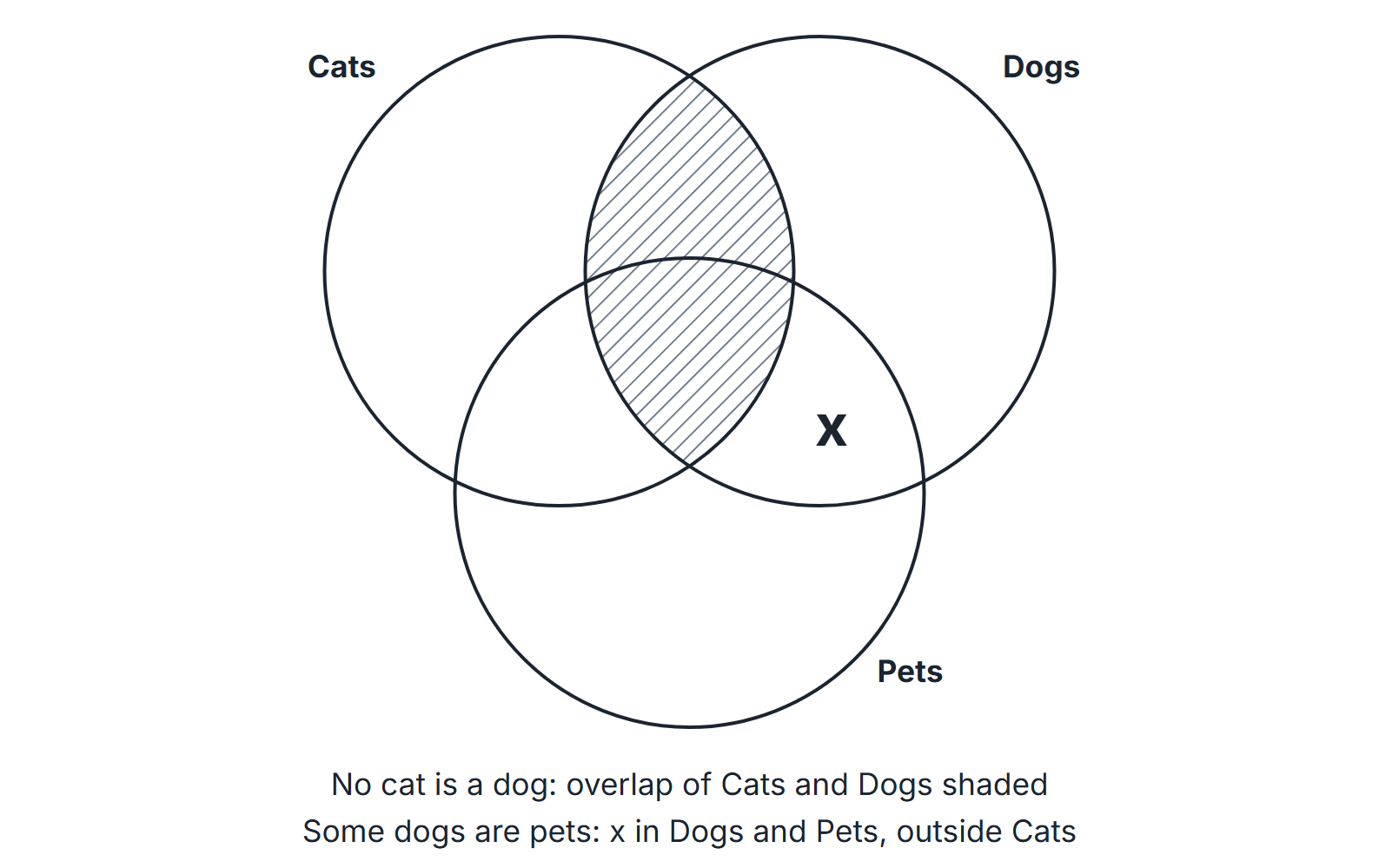
Example 3 (negative premise). No cat is a dog. Some dogs are pets (Figure 1).
- "Some pets are not cats" follows: the dogs that are pets are not cats.
- "Some pets are cats" does not follow, and neither does "No pet is a cat": both are possible.
Example 4 (undistributed middle). All A are B. Some B are C.
- "Some A are C" does not follow. Counterexample: A = squares, B = rectangles, C = rectangles that are not squares. All squares are rectangles, some rectangles are non-square rectangles, and no square is a non-square rectangle.
Example 5 (either-or). Premises as in Example 4, with conclusions (I) "Some A are C" and (II) "No A is C". Neither follows on its own, but they are a contradictory pair about A and C, and A is non-empty, so exactly one of them is true: the answer is "either I or II follows".
Example 6 (conditional patterns). "If it rains, the match is cancelled."
- The match was not cancelled, so it did not rain: valid (modus tollens).
- The match was cancelled, so it rained: invalid (affirming the consequent); the match may have been cancelled for another reason.
- It did not rain, so the match was not cancelled: invalid (denying the antecedent).
Example 7 (only if and unless). "You may board only if you have a boarding pass" means "board pass": a pass is necessary, not sufficient. "The plant will die unless it is watered" means "not watered dies"; it does not say that a watered plant survives.
Example 8 (negation). The negation of "All the trains were late" is "At least one train was not late", not "No train was late".
Example 9 (induction can fail). The expression is prime for every from 1 to 40. The generalisation "it is prime for every positive integer " is a strong-looking induction, and it is false: at the value is . Inductive conclusions can be strongly supported and still be false.
Example 10 (assumption, strengthen, weaken). Argument: "Sales of umbrellas rose sharply in July. Therefore July must have been unusually rainy."
- Necessary bridge. For the sales rise to support the rainfall conclusion, it must be evidence of rainfall rather than being explained entirely by unrelated factors. Negating that precise bridge removes the inference from sales to rainfall, although the rainfall conclusion could still happen to be true. “Nothing else contributed to sales” is a stronger supporting condition, not a necessary assumption: a discount and rain could both contribute.
- Strengthener: weather records show July rainfall well above the average for July.
- Weakener: the shops ran a half-price umbrella sale throughout July.
- Not relevant: umbrellas are also sold online. It does not bear on why sales rose.
Example 11 (some and none, three conclusions). Some A are B. No B is C. Conclusions: (I) Some A are not C. (II) No A is C. (III) Some C are not A.
- (I) follows: the A that are B cannot be C.
- (II) does not follow: other A, outside B, may be C.
- (III) does not follow: every C may lie inside A (outside B), and then no C is outside A.
- Venn check: shade the B and C overlap; mark the A and B overlap, which now sits outside C. Only (I) is forced.
Example 12 (possibility questions). All A are B. No B is C. Which are possible? (I) Some A are C. (II) All B are A.
- (I) is impossible: every A is inside B, and B shares nothing with C.
- (II) is possible: A and B may be the same class, and nothing in the premises forbids it.
- A possibility holds if at least one situation allowed by the premises makes it true; a conclusion "follows" only if every such situation makes it true.
Example 13 (two negative premises). No A is B. No B is C. Then nothing follows about A and C: A and C may overlap, or may be disjoint. Both "Some A are C" and "No A is C" are possible, and since A is non-empty they form a contradictory pair, so in a two-conclusion question the answer is "either I or II follows", while "Some A are not C" does not follow (all of A may be inside C).
Example 14 (implicit assumptions). Statement: "The city should build more flyovers to reduce traffic jams." Assumptions: (I) Flyovers help reduce traffic jams. (II) The city has no other problems.
- (I) is implicit: if flyovers did not help, the recommendation would make no sense (negate it and the argument collapses).
- (II) is not implicit: the statement can be reasonable even if the city has other problems.
Example 15 (inference: definitely true or not). Statement: "All the shops in the market close on Sundays. Ravi bought groceries in the market today." Inferences: (I) Today is not Sunday. (II) Ravi buys groceries every day.
- (I) follows, provided the groceries were bought in a shop in the market (modus tollens on "if Sunday, then closed").
- (II) does not follow: one purchase says nothing about every day.
Important properties and observations
- Valid is not true. "All fish can fly; all sparrows are fish; so all sparrows can fly" is valid with false premises. Judge only by the premises.
- Two particular premises never yield a conclusion in a syllogism, and neither do two negative premises.
- A negative premise forces a negative conclusion (if any conclusion follows).
- Common misconceptions. "Some A are B" implies "Some A are not B" (it does not; all A may be B). "Only if" means "if" (it reverses the direction). The converse of a true conditional is true (not necessarily).
- Necessary versus sufficient. In , is sufficient for and is necessary for .
- EDGE CASE. Without the existence convention, "All S are P" would not imply "Some S are P"; if a question explicitly allows empty classes, re-check every conclusion that relies on existence (such as the third bullet of Example 1).
GATE examination perspective
- Syllogism questions. Several conclusions are offered; check each with the Venn method and watch for the either-or pair (Examples 3 to 5).
- Converse traps. Reversing "All A are B" or a conditional is a typical invalid option (Examples 1 and 6).
- Language traps. "Only if", "unless" and "no ... without" change direction; translate before judging (Example 7).
- Negation traps. The negation of "all" is "not all" (Example 8).
- Critical-reasoning questions. Identify evidence, conclusion and gap; the correct strengthener or weakener addresses the gap, not a side issue (Example 10).
- Real-world knowledge traps. In deduction questions, a conclusion that is true in reality but does not follow from the premises is wrong.
- Some and none together. "Some A are B" with "No B is C" gives exactly "Some A are not C" (Example 11).
- Possibility versus certainty. A possibility needs one allowed situation; a conclusion needs all of them (Example 12).
- Two negative premises. No categorical conclusion about the end terms follows, though an either-or pair may (Example 13).
- Assumptions and inferences. Use the negation test for assumptions; an inference must be forced by the statement (Examples 14 and 15).
Summary
Sources
- N. Smith et al., Introduction to Philosophy, OpenStax, 2022: Section 5.3 Arguments; Section 5.4 Types of Inferences; Section 5.5 Informal Fallacies. (consulted 2026-11-11).
- D. Kirk et al., Contemporary Mathematics, OpenStax, 2023: Section 1.3 Understanding Venn Diagrams; Section 1.5 Set Operations with Three Sets; Section 2.4 Truth Tables for the Conditional and Biconditional; Section 2.5 Equivalent Statements; Section 2.7 Logical Arguments. (consulted 2026-11-11).