
Introduction
A function is recursive when it calls itself, directly or through other functions. Recursion expresses a problem in terms of smaller instances of the same problem: the factorial of is times the factorial of ; a binary tree is a root with two smaller binary trees. The working task is to take a short recursive C function and find its output, its return value, or how many calls it makes.
This note covers how recursion executes, the main forms of recursion, and standard examples with their costs. The companion note Recursion Tracing and Call Counting gives systematic methods for tracing.
Conventions: C11, hosted; outputs are for gcc on x86-64 Linux.
Prerequisites
- Functions and Parameter Passing: call by value, return values.
- Control Flow:
if,return.
Core concepts
Base case and recursive case
Every correct recursive function has:
- One or more base cases, answered without a recursive call.
- A recursive case that calls the function on an argument closer to a base case under some measure (smaller , shorter list, smaller subtree).
/* Domain: n >= 0; all intermediate products must fit long; sufficient stack. */
long fact(int n) {
    if (n <= 1) return 1;          /* base case */
    return n * fact(n - 1);        /* recursive case: n decreases */
}
A missing or unreachable base case gives unbounded recursion. In practice this exhausts the call stack and the program crashes; the C standard sets no recursion limit, and the failure mode is outside the language.
How a recursive call executes
Each call, recursive or not, gets its own activation record (stack frame) holding its parameters, automatic variables and the return address. A recursive call does not overwrite the caller's n; it creates a new n.
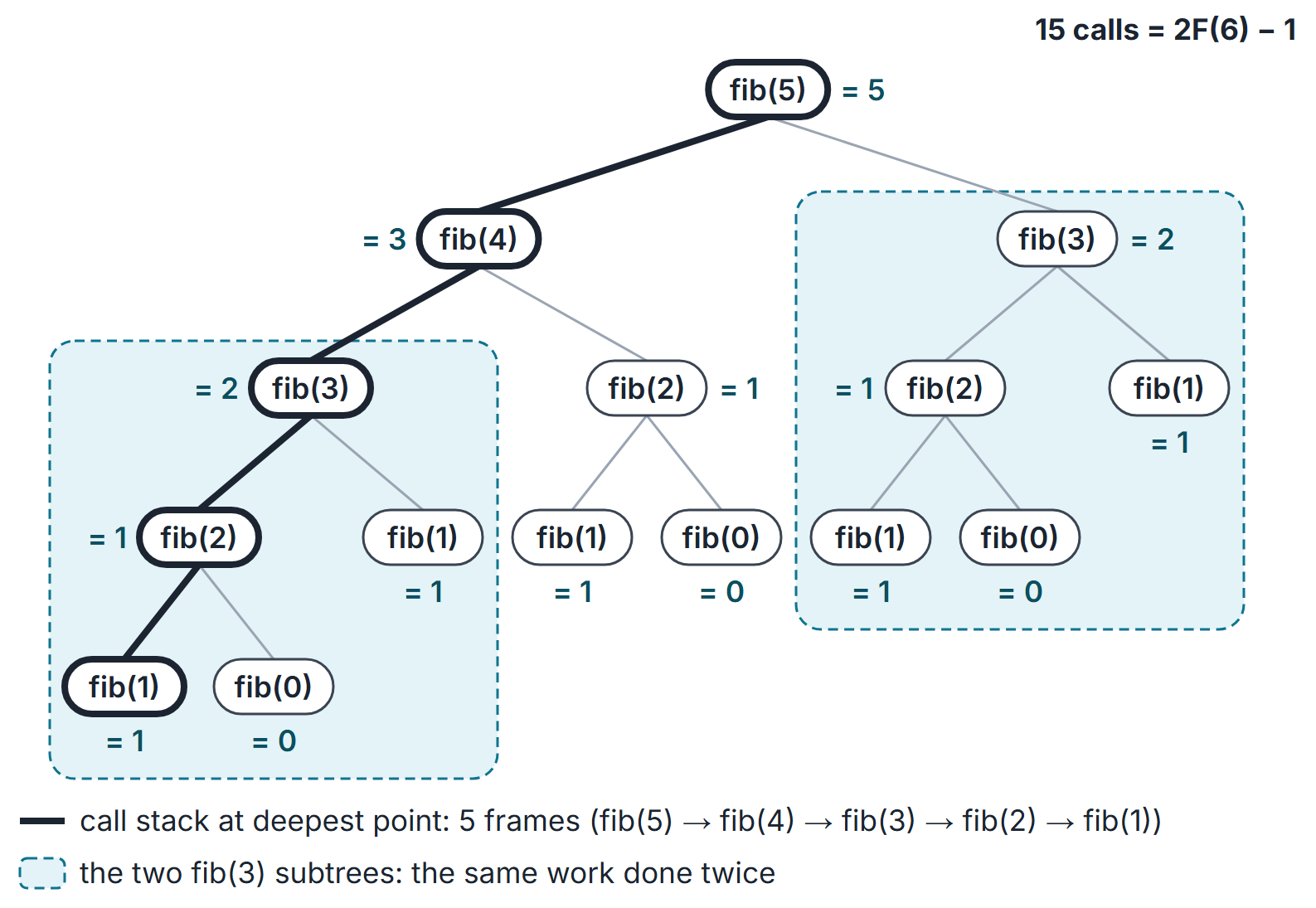
- The recursion depth is the largest number of frames active at once, the height of the recursion tree plus one. Space is proportional to depth only when each frame has constant-sized local/auxiliary storage. Generally sum frame-local and allocated auxiliary storage over simultaneously live calls; call count alone also does not determine time when work per call varies.
- The total number of calls equals the number of nodes in the recursion tree, and governs the running time.
- Calls are winding (going down) until a base case returns; then the frames unwind in last-in first-out order. This is why recursion can always be simulated with an explicit stack.
For sum(n) = n + sum(n - 1) with sum(0) = 0, the call sum(100) returns 5050 with a maximum depth of 101 frames (sum(100) down to sum(0)).
Forms of recursion
| Form | Definition | Example |
|---|---|---|
| Direct | f calls f | fact |
| Indirect (mutual) | f calls g, g calls f | is_even and is_odd |
| Linear | at most one recursive call per activation | fact, sum |
| Tree (multiple) | two or more recursive calls per activation | fib, Tower of Hanoi |
| Tail | the recursive call is the last action; its result is returned unchanged | gcd, fact_acc |
| Non-tail | work remains after the call returns | fact (multiplies after returning) |
| Nested | an argument is itself a recursive call | Ackermann: A(m-1, A(m, n-1)) |
Mutual recursion example:
int is_even(int n);                                   /* declaration needed first */
/* Both parity routines require n >= 0 and sufficient stack. */
int is_odd(int n)  { return n == 0 ? 0 : is_even(n - 1); }
int is_even(int n) { return n == 0 ? 1 : is_odd(n - 1); }
is_even(10) is 1 and is_odd(7) is 1.
Tail recursion and accumulators
A non-tail function can often be made tail recursive by carrying the pending work in an accumulator parameter:
long fact_acc(int n, long acc) {           /* call as fact_acc(n, 1) */
    return n <= 1 ? acc : fact_acc(n - 1, acc * n);
}
A tail call can be replaced by a jump back to the start of the function with updated parameters, which is exactly a loop. Compilers often perform this optimisation, but C does not require it, so a tail recursive C function may still use stack.
Order of work: before or after the call
Where the output statement sits relative to the recursive call decides the order:
/* down/up require n >= 0 and sufficient stack. */
void down(int n) { if (n == 0) return; printf("%d ", n); down(n - 1); }  /* 4 3 2 1 */
void up(int n)   { if (n == 0) return; up(n - 1); printf("%d ", n); }    /* 1 2 3 4 */
Work done before the call happens while winding (in call order); work done after happens while unwinding (in reverse order). The same idea separates preorder and postorder tree traversals.
How it works: costs of standard recursions
The number of calls and the running time satisfy recurrences read directly from the code.
| Function | Recurrence for calls | Calls / time | Depth |
|---|---|---|---|
fact(n), sum(n) | |||
fib(n) naive | , | ||
power(x, n) by halving | , | for | |
hanoi(n) | , moves | moves | |
gcd(a, b) (Euclid) | one call per remainder step | for positive | same |
Here is the -th Fibonacci number (, ) and .
Why . Let . Then with , so . Checks: and .
Why naive Fibonacci is slow. The same subproblems are recomputed: fib(5) computes fib(3) twice and fib(2) three times. Memoisation stores each result the first time it is computed, so each of fib(0) to fib(n) is evaluated once and the time becomes . This is the idea behind dynamic programming.
Standard functions
/* fib/power/hanoi/digsum: n >= 0; all arithmetic must fit its result type. */
/* gcd: positive a,b for the logarithmic bound; exclude INT_MIN % -1. */
/* Mathematical asymptotics assume unbounded inputs; C also needs sufficient stack. */
int fib(int n) { return n < 2 ? n : fib(n - 1) + fib(n - 2); }

long power(long x, int n) {                /* x^n, n >= 0 */
    if (n == 0) return 1;
    long h = power(x, n / 2);              /* one recursive call, reused */
    return n % 2 ? h * h * x : h * h;
}

void hanoi(int n, char from, char to, char via) {
    if (n == 0) return;
    hanoi(n - 1, from, via, to);           /* move n-1 out of the way */
    /* move disk n from 'from' to 'to' */
    hanoi(n - 1, via, to, from);           /* move n-1 on top of it */
}

int gcd(int a, int b) { return b == 0 ? a : gcd(b, a % b); }
int digsum(int n) { return n < 10 ? n : n % 10 + digsum(n / 10); }   /* n >= 0 */
Writing power(x, n/2) * power(x, n/2) instead of saving h makes two calls per level, and the call count becomes instead of .
Worked examples
All outputs below are for C11 with gcc on x86-64 Linux (LP64).
Example 1. fact(5) is 120 and fact_acc(10, 1) is 3628800.
Example 2. fib(5) returns 5 and makes 15 calls; fib(10) returns 55 and makes 177 calls.
Example 3. power(3, 13) is 1594323, with 5 calls: . power(2, 10) is 1024.
Example 4. hanoi(4, ...) makes moves.
Example 5. gcd(84, 36): . digsum(9475) is .
Example 6 (an evaluation-order trap). In printf("%d %d\n", sum(100), maxdepth); where sum updates the global maxdepth, the order in which the two arguments are evaluated is unspecified. With gcc on x86-64 the arguments are evaluated right to left, so maxdepth is read first and 0 is printed. Call sum in a separate statement first. See Operators and Expressions.
Important properties and observations
- Correctness argument = induction: prove the base cases, then assume the calls on smaller arguments are correct and show the current call is.
- Recursion can be rewritten iteratively with an explicit stack. An equivalent tail-recursion-eliminated iterative form uses auxiliary call-stack space if local storage is constant; the recursive C source itself has no guaranteed tail-call optimization.
- With constant-sized frames and no other live auxiliary allocations, stack space is . In general sum storage over live calls and work over all calls; multiply call count by a per-call cost only when that cost is uniform or an explicit bound.
- Each activation has its own automatic variables, but a
staticlocal or a global is shared by all activations. A recursive function with astaticcounter behaves very differently from one with an automatic counter; see Scope, Storage Classes and Linkage. - Recursion trees with repeated subtrees signal that memoisation or dynamic programming would help.
GATE examination perspective
- Output of a recursive function with
printfbefore and after the call: separate winding output from unwinding output. - Return value questions: evaluate bottom-up from the base case, writing a small table of .
- Number of calls or additions: draw the recursion tree or write the recurrence; for Fibonacci-like code use calls.
staticvariables inside recursive functions: one copy shared across calls.- Tower of Hanoi: moves.
- Complexity: set up and solve (see the algorithms notes on recurrences).
Summary
Sources
- B. W. Kernighan and D. M. Ritchie, The C Programming Language, 2nd ed., Prentice Hall, 1988: Section 4.10 (recursion).
- T. H. Cormen, C. E. Leiserson, R. L. Rivest, C. Stein, Introduction to Algorithms, 3rd ed., MIT Press, 2009: Chapter 4 (recurrences), Chapter 15 (dynamic programming, memoisation).
- ISO/IEC 9899:2011 (C11), committee draft N1570, (consulted 2026-11-09), Section 6.5p3 (evaluations of subexpressions unsequenced unless specified), Section 6.5.2.2p10 (sequence point after the arguments are evaluated, before the call), p11 (recursive calls permitted, directly and indirectly) and p12 (EXAMPLE: argument functions may be called in any order).