
Introduction
When many stations share one broadcast channel (a coaxial cable, a hub, a radio frequency), two frames sent at overlapping times destroy each other: a collision. The medium access control (MAC) sublayer of the data link layer decides who may transmit when.
There are three families. Channel partitioning (TDMA, FDMA) gives each station a fixed share; it is collision-free but wastes the share of idle stations. Taking turns (polling, token passing) passes the right to send around; it is collision-free but has overhead and a single point of failure. Random access lets any station send when it has data and recovers from collisions; it is simple and efficient at light load. ALOHA, slotted ALOHA, CSMA and CSMA/CD are random-access protocols, and classic Ethernet is CSMA/CD.
The quantities are throughput formulas and their maxima ( and ), vulnerable periods, the minimum frame size for collision detection, binary exponential backoff probabilities, and CSMA/CD efficiency.
Prerequisites
- Network Performance Metrics: Delay, Throughput and BDP: transmission time , propagation time , and .
- Poisson arrivals: if events occur at rate , the number in an interval of length is Poisson with mean , and the chance of none is .
Core concepts
Load and throughput
Measure time in frame times (the transmission time of one frame, all frames of equal length). Let be the offered load: the mean number of transmission attempts (new frames and retransmissions) per frame time. Let be the throughput: the mean number of successful frames per frame time, so . Attempts are modelled as a Poisson process.
Pure ALOHA
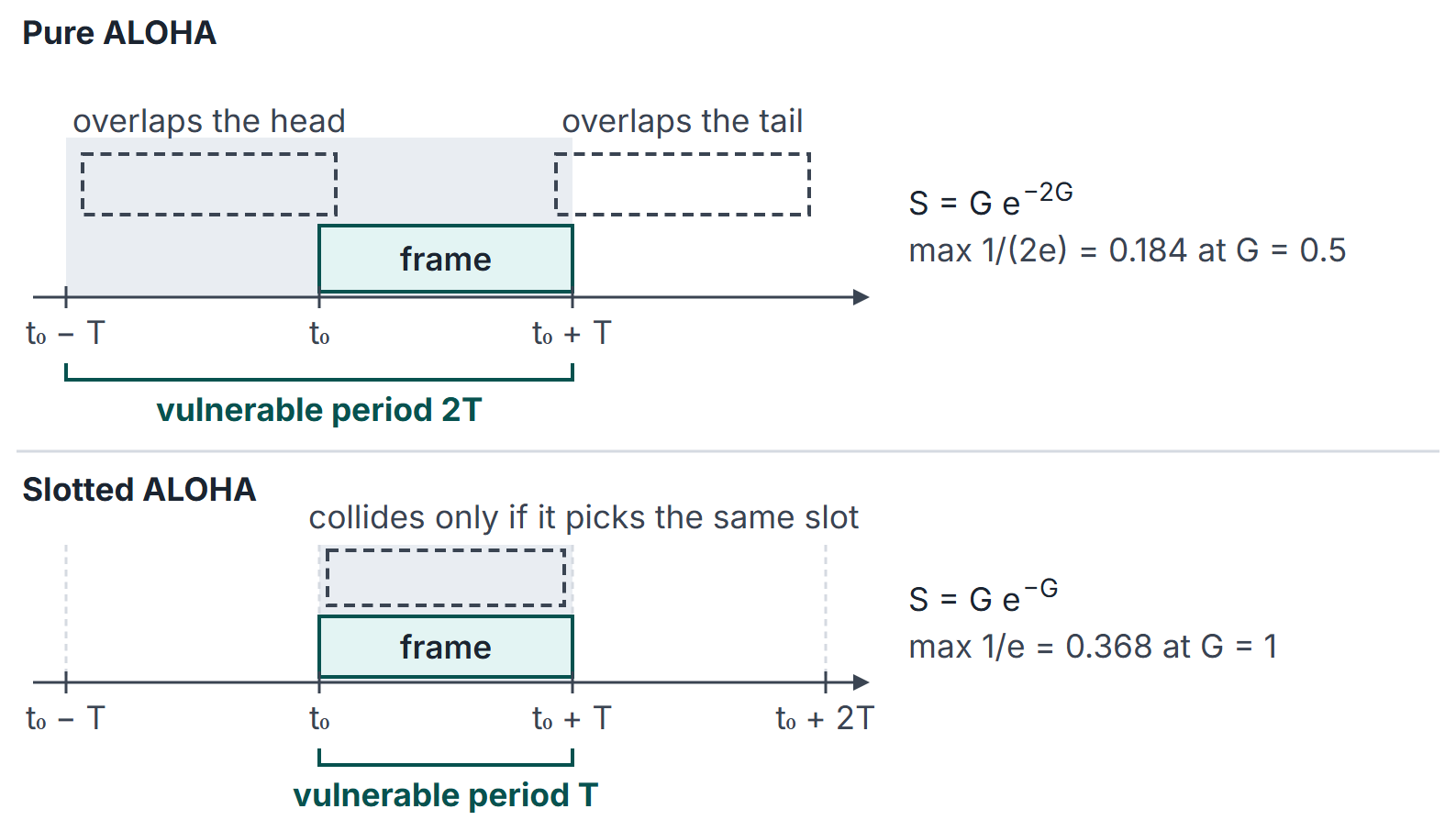
A station sends whenever it has a frame. If it collides, it waits a random time and sends again. A frame sent at time survives only if no other frame starts in : any frame starting in the previous is still on the channel, and any frame starting in the next overlaps its tail. The vulnerable period is , so
Slotted ALOHA
Time is divided into slots of length ; a frame may start only at a slot boundary. Two frames collide only if they choose the same slot, so the vulnerable period is :
Finite-station form
With stations each transmitting in a slot with probability , a slot succeeds if exactly one transmits:
The slotted expression is largest at , where it equals , which falls to as . The pure expression is largest at and tends to .
CSMA: listen before talking
Carrier sense multiple access stations sense the channel and do not start while another transmission is heard. Collisions remain possible because a signal needs time to reach the other stations: the vulnerable period becomes the propagation delay.
| Variant | Channel busy | Channel idle |
|---|---|---|
| 1-persistent | Keep sensing; send the moment it goes idle | Send at once |
| Non-persistent | Wait a random time, then sense again | Send at once |
| -persistent (slotted) | Wait for the next slot and sense again | Send with probability ; otherwise wait one slot and repeat |
1-persistent has the least delay at light load but collides whenever two stations are waiting for the same frame to end. Non-persistent wastes idle time but collides less at heavy load.
CSMA/CD: detect and abort
With collision detection a station listens while it sends. On detecting a collision it stops at once, sends a short jam signal so every station notices, and backs off. This saves the rest of the frame time that ALOHA and plain CSMA waste on a doomed frame.
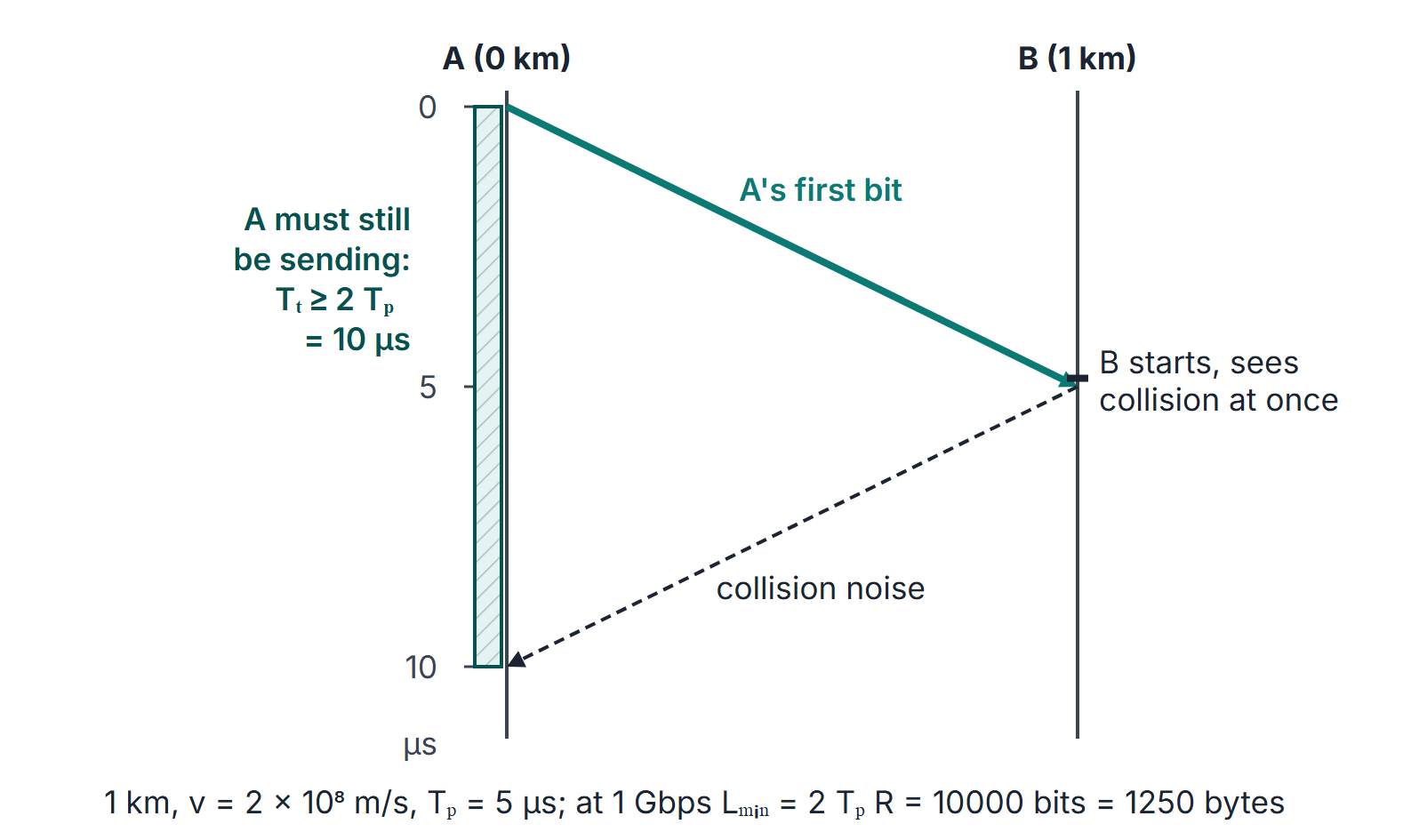
Minimum frame size. A sender can only know that a collision happened if it is still transmitting when the collision noise reaches it. In the worst case, station A at one end starts at time 0; just before A's first bit reaches the far end at , station B starts; B's signal reaches A at almost . So
Classic 10 Mbps Ethernet fixes the slot time at 512 bit times (51.2 µs) and the minimum frame at 64 bytes, which bounds the network diameter.
Binary exponential backoff
After the -th consecutive collision of a frame, the station picks uniformly from with and waits slot times (512 bit times) before sensing again. After 16 failed attempts the frame is dropped and an error is reported. The range doubles with each collision, so the expected wait adapts to the number of contending stations.
Mathematical explanation
Throughput of pure ALOHA. A given attempt succeeds if no other attempt occurs in a window of , which for Poisson attempts at rate per frame time has probability . Attempts occur at rate , so . Setting gives and . For slotted ALOHA the window is one slot, , maximum at , .
CSMA/CD efficiency. Two standard models give approximations of the same shape:
with and the maximum end-to-end propagation delay. In the Tanenbaum model each contention slot has length and, with optimal persistence among many stations, a slot is won with probability , so on average slots of precede each frame. Both formulas give as (long frames, short cable) and as grows.
Backoff probabilities. If two stations pick independently and uniformly from ranges of sizes and , they collide again with probability ; for equal ranges of size , that is .
Worked examples
Example 1: ALOHA throughput
200-bit frames on a 200 kbps channel, so ms. Pure ALOHA:
| Frames offered per second | Successful frames per second | ||
|---|---|---|---|
| 1000 | 1 | 0.1353 | about 135 |
| 500 | 0.5 | 0.1839 | about 184 |
| 250 | 0.25 | 0.1516 | about 152 |
Slotted ALOHA at (1000 frames per second offered) gives , about 368 frames per second. Successful frames per second are , that is times 1000 here; equivalently, the offered frames per second times the survival probability (for 500 frames per second, ). Multiplying by the offered frames per second counts the load twice and gives a wrong answer such as 92.
Example 2: finite stations
Ten stations, each sending in a slot with probability 0.1: . This is the maximum over for , already close to from above.
Example 3: minimum frame size
A 1 km cable at 1 Gbps, m/s: µs, so bits (1250 bytes). At 10 Mbps over 2500 m: µs and bits.
Reverse question: with 64-byte (512-bit) minimum frames at 100 Mbps, µs, so µs and the cable can be at most m.
Example 4: CSMA/CD efficiency
With : in the Kurose and Ross form, in the Tanenbaum form. With : 0.952 and 0.948.
Example 5: backoff
Stations A and B collide. Each picks : they collide again with probability . After a second collision each picks from : probability .
Now suppose A is on its first retry () and B on its second (). A wins outright if : if , B must pick 1, 2 or 3 (probability ); if , B must pick 2 or 3 (). So . B wins only if and , probability ; they collide again () with probability , which matches .
Example 6: when each station detects the collision
A 2 km bus with m/s ( µs) at 10 Mbps. A starts sending at time 0. B, at the far end, starts at 6 µs, because A's first bit reaches B only at 10 µs and B still hears an idle channel. The two signals meet at 8 µs, 1600 m from A. B hears A at 10 µs, after sending for 4 µs (40 bits); A hears B at µs, after sending 160 bits. The later B starts, the later A finds out: if B starts just before 10 µs, A hears the collision just before µs. So A's frame must last at least 20 µs, which is 200 bits, the value gives.
Important properties and observations
- Vulnerable periods. Pure ALOHA ; slotted ALOHA ; CSMA .
- Maxima. at ; at . Beyond the maximum, extra load lowers throughput.
- CSMA/CD needs . That is the entire basis of the 64-byte minimum Ethernet frame and of padding short frames.
- CSMA/CD needs a wired medium. On radio a station cannot hear collisions at the receiver while transmitting (and hidden stations exist), so Wi-Fi uses collision avoidance instead.
- Switched full-duplex Ethernet has no collisions, so CSMA/CD is inactive there (Ethernet, Switches and Bridges).
Common misconceptions.
- "ALOHA's maximum is 18.4% of the offered load." It is 18.4% of the channel capacity, reached when the offered load is half a frame per frame time.
- "Doubling the bit rate keeps the minimum frame the same." doubles with .
- "Backoff uses values." After the -th collision there are values, to .
Related material. Collision-free and wireless access
Polling (a master invites each station in turn) and token passing (a token circulates; only its holder sends) avoid collisions at the cost of polling or token-rotation delay.
Token-passing cycle. Let stations share a ring; a station holding the token sends one frame (time ) if it has data and passes the token on as soon as it has finished, and the token needs a total ring latency to travel once round the ring. With every station busy, one rotation takes , so the efficiency is . For , µs and µs (5 µs per hop): a rotation takes 1050 µs, the efficiency is , and a busy station waits 950 µs between the end of one of its frames and the start of its next. If only one station has data, it sends once every µs and gets of the link. The ratio of to plays the part that plays in CSMA/CD.
Wi-Fi uses CSMA/CA: a station senses the channel, defers for a random backoff counted down only while the channel is idle, and relies on link-layer acknowledgements because it cannot detect collisions.
GATE examination perspective
- Throughput questions. Convert the offered frames per second into per frame time, then use or . is successes per frame time: divide by for successes per second; do not multiply by the offered rate.
- Maxima and where they occur. for pure, for slotted.
- Minimum frame or maximum length. ; solve for or as asked. Use the one-way end-to-end propagation delay.
- Backoff probabilities. Enumerate the pairs; the ranges are after the -th collision.
- Who detects first. Trace both signal fronts: the station that started later hears the other first; the earlier sender can need almost (Example 6).
- Efficiency formula. Use the one the question's options imply; both models give with about 5.
Summary
Sources
- A. S. Tanenbaum, D. J. Wetherall, Computer Networks, 5th ed., Pearson, 2011, Section 4.2.1 (ALOHA), Section 4.2.2 (Carrier Sense Multiple Access Protocols), Section 4.2.3 (Collision-Free Protocols), Section 4.3.2 (Classic Ethernet MAC Sublayer Protocol, binary exponential backoff) and Section 4.3.3 (Ethernet Performance).
- J. F. Kurose, K. W. Ross, Computer Networking: A Top-Down Approach, 8th ed., Pearson, 2021: Section 6.3.2 (Random Access Protocols: slotted ALOHA, ALOHA, CSMA, CSMA/CD and its efficiency).
- B. A. Forouzan, Data Communications and Networking, 5th ed., McGraw-Hill, 2013: Chapter 12 (Media Access Control).