
Introduction
A hard disk drive (HDD) stores data on spinning platters and reads it with heads on a moving arm. Reaching a block means moving the arm to the right track and waiting for the right sector to rotate under the head, and both waits are mechanical: milliseconds, millions of times slower than a memory access. When many requests are pending, the order in which they are served changes the total arm movement a great deal. Disk scheduling chooses that order.
Disk geometry, addressing and the components of access time fix the cost of a request. The six classical scheduling algorithms (FCFS, SSTF, SCAN, C-SCAN, LOOK and C-LOOK) are run on one request queue, with the conventions that decide the numerical answer: the initial head direction, whether SCAN and C-SCAN travel to the end of the disk, and whether the return sweep of C-SCAN and C-LOOK is counted.
Prerequisites
- Operating System Structure and System Calls: a
readorwritesystem call becomes a request to the device driver, which queues it for the disk.
Core concepts
Disk geometry
| Term | Meaning |
|---|---|
| Platter | A rigid disk coated on both sides; several are stacked on one spindle |
| Surface | One side of a platter, with one read-write head |
| Track | A concentric ring on a surface |
| Sector | The smallest addressable unit on a track (traditionally 512 bytes; 4 KB on newer drives) |
| Cylinder | The set of tracks at the same arm position on all surfaces |
| Arm assembly | Moves all heads together, so all heads are always on the same cylinder |
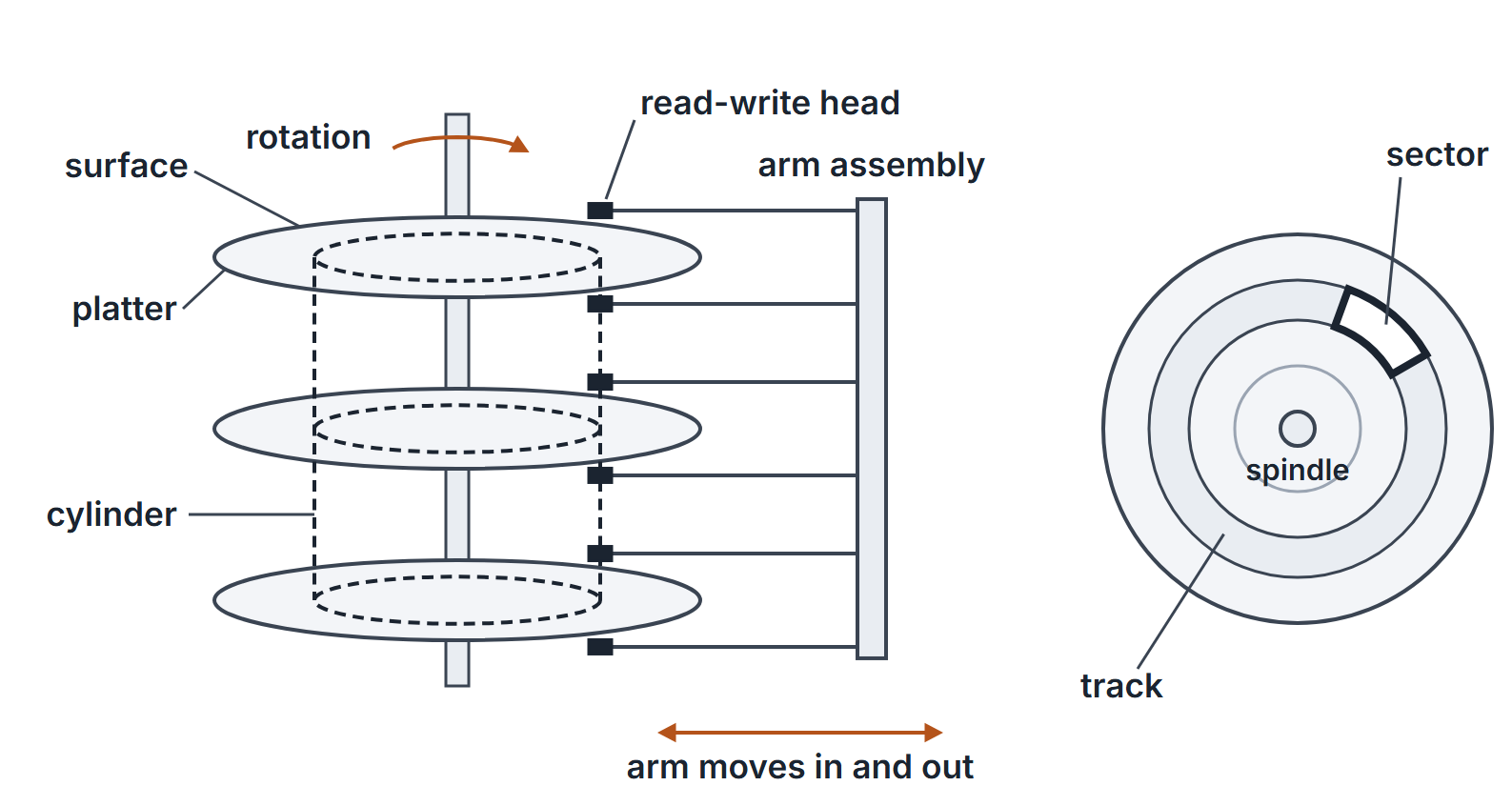
Capacity. Capacity = surfaces tracks per surface sectors per track bytes per sector (if every track has the same number of sectors). A drive with 8 surfaces, 10,000 cylinders, 500 sectors per track and 512-byte sectors holds bytes. Real drives use zoned recording: outer tracks hold more sectors than inner ones, so the formula applies per zone.
Logical block addressing. The drive presents a linear array of logical blocks. The traditional mapping goes sector by sector along a track, then head by head through a cylinder, then cylinder by cylinder. With heads, sectors per track and sectors numbered from 1:
With and , cylinder 2, head 3, sector 10 is LBA .
Access time
- Seek time: moving the arm to the cylinder. Quoted as an average; scheduling tries to reduce the total.
- Rotational latency: waiting for the sector. At revolutions per second, one revolution takes ; the average latency is half a revolution.
- Transfer time: the fraction of a revolution occupied by the sectors read. Reading of the sectors of a track takes of a revolution.
Example. 7,200 RPM, average seek 4 ms, 500 sectors of 512 bytes per track. One revolution takes s ms, so the average rotational latency is 4.167 ms. Reading one 4 KB block (8 sectors) takes of a revolution ms, and the access costs ms. The sustained transfer rate from one track is bytes per 8.333 ms bytes per second.
Random versus sequential. A 2 MB file is 512 blocks of 4 KB. Read as 512 random blocks it costs ms. Stored contiguously it costs one seek and one latency plus the transfer of 4,096 sectors, revolutions or 68.267 ms: about 76.43 ms in total, ignoring track-to-track switches. This is why allocation that keeps files contiguous matters (see File Allocation Methods and Free-Space Management).
Seek versus movement. The standard measure is total head movement in cylinders. If a question gives a time per cylinder crossed, multiply: 250 cylinders at 0.1 ms each is 25 ms of seeking.
The scheduling algorithms
Pending requests are cylinder numbers. The algorithms differ only in the order of service.
| Algorithm | Rule | Starvation | Notes |
|---|---|---|---|
| FCFS | Serve in arrival order | No | Fair, often long movement |
| SSTF | Serve the pending request closest to the head | Yes: far requests can wait forever | Greedy; not optimal |
| SCAN (elevator) | Move in one direction serving requests, go on to the last cylinder, then reverse | No | Requests near the middle wait less on average than those near the edges |
| LOOK | As SCAN, but reverse at the last request in the current direction | No | The usual implementation of "SCAN" |
| C-SCAN | Move in one direction to the last cylinder, return to the first cylinder without serving, continue in the same direction | No | More uniform waiting time |
| C-LOOK | As C-SCAN, but stop at the last request in the sweep direction; upward jumps highest-to-lowest pending, downward lowest-to-highest pending | No | The usual implementation of "C-SCAN" |
Conventions to fix before computing.
- Direction. SCAN, LOOK, C-SCAN and C-LOOK need an initial direction. A question gives it directly, or gives the previously served cylinder: from 90 to 100 means the head is moving towards higher cylinders.
- End of disk. SCAN and C-SCAN travel to the last cylinder (199 here) before reversing or returning, even if no request lies there; LOOK and C-LOOK do not.
- Return sweep. Whether the return of C-SCAN (199 to 0) or the jump of C-LOOK (highest-to-lowest pending for an upward sweep, lowest-to-highest for a downward sweep) counts as head movement. Many textbooks count it (it is real arm motion, though fast); some questions say it is not counted. Give the total the question asks for, and state which.
- Ties in SSTF. If two requests are equally close, a tie rule is needed; the traces take the lower cylinder.
Algorithms and pseudocode
SCHEDULE-LOOK(head, Q, dir):            -- dir is UP or DOWN; Q is a set of cylinders
    order <- empty list
    if dir = UP then
        append the requests >= head, ascending, to order
        append the requests < head, descending, to order
    else
        append the requests <= head, descending, to order
        append the requests > head, ascending, to order
    return order
SCAN differs only by visiting the last cylinder before reversing (if any request remains on the other side); C-SCAN and C-LOOK append the second group in the same direction as the first. Each of these orders costs for requests (a sort); SSTF done naively costs , with a balanced search tree keyed on cylinder.
Worked example: one queue, six algorithms
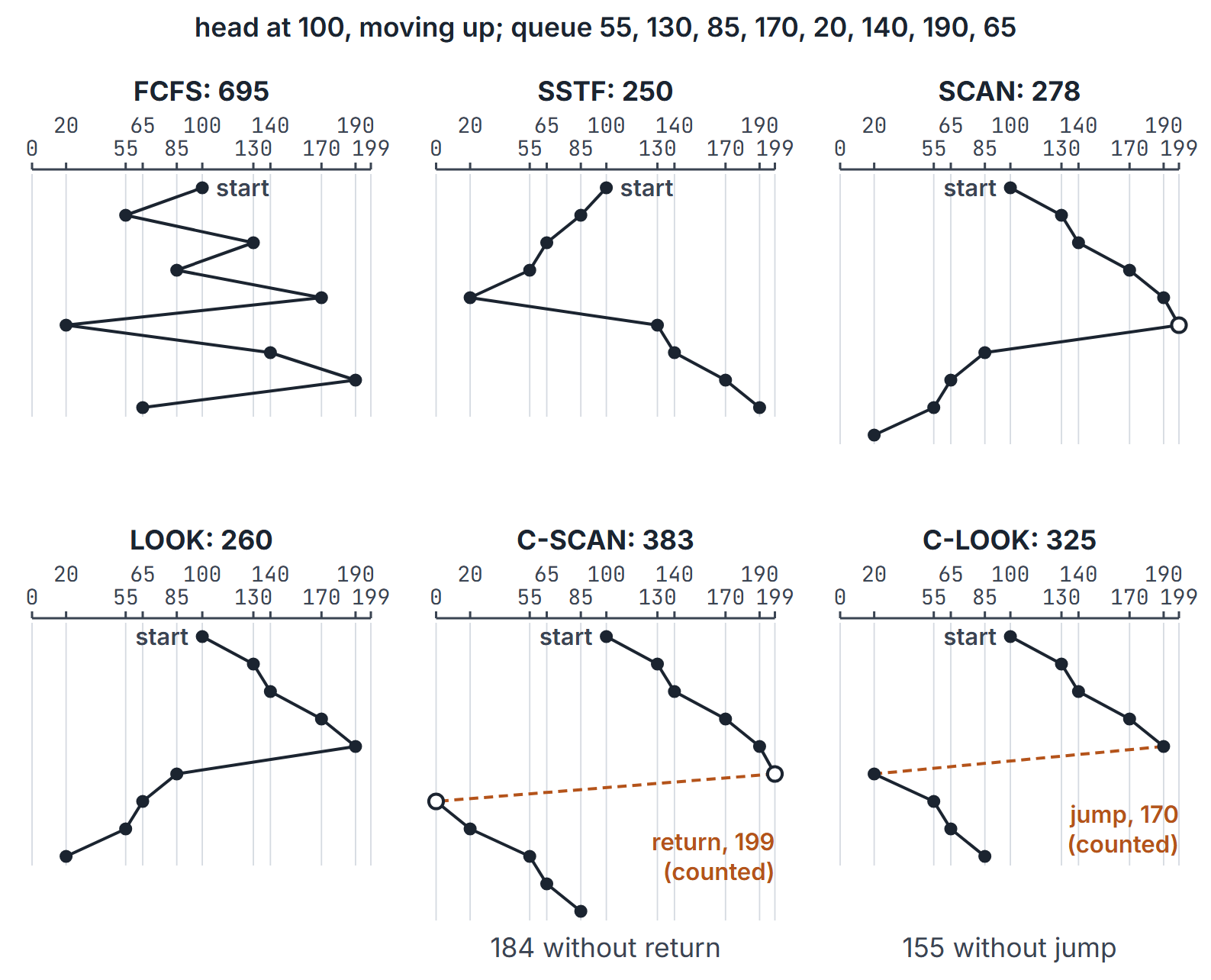
Cylinders 0 to 199. The head is at cylinder 100, moving towards higher cylinders (the previous request was at 90). Queue, in arrival order:
| Algorithm | Order of service | Total movement |
|---|---|---|
| FCFS | 100, 55, 130, 85, 170, 20, 140, 190, 65 | 695 |
| SSTF | 100, 85, 65, 55, 20, 130, 140, 170, 190 | 250 |
| SCAN | 100, 130, 140, 170, 190, (199), 85, 65, 55, 20 | 278 |
| LOOK | 100, 130, 140, 170, 190, 85, 65, 55, 20 | 260 |
| C-SCAN | 100, 130, 140, 170, 190, (199), (0), 20, 55, 65, 85 | 383 with the return, 184 without |
| C-LOOK | 100, 130, 140, 170, 190, 20, 55, 65, 85 | 325 with the jump, 155 without |
Cylinders in parentheses are reached by the arm but have no request.
- FCFS: .
- SSTF: from 100 the nearest is 85 (15), then 65 (20), 55 (10), then 20 (35, closer than 130 at 75), then 130 (110), 140, 170, 190 (10, 30, 20): total 250. SSTF went down first although the head was moving up; direction plays no part in SSTF.
- SCAN: up to 199 (99), then down to 20 (179): 278.
- LOOK: up to 190 (90), then down to 20 (170): 260.
- C-SCAN: up to 199 (99), return to 0 (199), up to 85 (85): 383; without the return, .
- C-LOOK: up to 190 (90), jump to 20 (170), up to 85 (65): 325; without the jump, .
Same queue, head moving down. SCAN: 100, 85, 65, 55, 20, (0), 130, 140, 170, 190, total . LOOK: . C-SCAN: down to 0, return to 199, down to 130: . C-LOOK: down to 20, jump to 190, down to 130: . The direction changes every answer except FCFS and SSTF.
From head movement to service time
Use the disk of the access-time example (average rotational latency 4.167 ms, 0.133 ms to transfer one 4 KB block) and suppose the arm needs 0.1 ms per cylinder moved. Each of the 8 requests in the worked queue reads one block.
| Schedule | Cylinders | Seek time | Latency and transfer | Total |
|---|---|---|---|---|
| FCFS | 695 | 69.5 ms | ms | 103.9 ms |
| SSTF | 250 | 25.0 ms | 34.4 ms | 59.4 ms |
Scheduling changes only the seek term; rotational latency and transfer are paid once per request whatever the order. The gain from scheduling therefore shrinks as latency and transfer grow relative to seek time.
An SSTF tie
Head at 50, requests 40, 60 and 90. Both 40 and 60 are 10 cylinders away.
- Lower first (the tie rule used in the traces): 50, 40, 60, 90, moving cylinders.
- Higher first: 50, 60, 40, 90, moving cylinders. After 60 the nearest request is 40 (20 away), not 90 (30 away): SSTF re-chooses at every step.
The tie rule changes the total from 60 to 80 cylinders, so a question must state it; when it does not, say which rule you used.
Important properties and observations
- SSTF minimises each next seek, not the total; it can starve requests far from a busy region and is not optimal in general. With the head at 10 and requests 0, 15 and 25, SSTF serves 15, 25, 0 for cylinders, while 0, 15, 25 costs . (On the worked example SSTF's 250 happens to be optimal.)
- SCAN and LOOK bound the wait of every request by about two sweeps; C-SCAN and C-LOOK by about one sweep plus the return, giving more uniform waiting times.
- LOOK never moves more than SCAN on the same queue and direction, and C-LOOK never more than C-SCAN, under the same counting convention.
- Scheduling is often less consequential with little queueing, but sweep algorithms can still incur extra movement depending on direction and end-of-disk conventions.
- On solid-state drives there is no seek or rotation, so simple FCFS ordering (with merging of adjacent requests) is common; the six algorithms are about mechanical disks.
Common misconceptions.
- "SCAN reverses at the last request." That is LOOK; SCAN goes to the end of the disk.
- "SSTF is optimal." It is greedy; the queue order it produces can be beaten, and it can starve requests.
- "The C-SCAN return is free." It is real arm movement; whether it is counted is a convention.
GATE examination perspective
- Read the conventions first. Direction (or previous cylinder), disk range, end-of-disk travel, and whether the return sweep counts.
- Totals by segments. For sweep algorithms, total movement is the sum of the straight segments (up, then down or jump), not of each hop.
- Seek time from movement. Multiply cylinders by the time per cylinder if given; add rotational latency and transfer only if the question asks for access time.
- Access-time arithmetic. Average latency is half a revolution; transfer time is the fraction of the track read.
- CHS and LBA conversions. Fix whether sectors start at 0 or 1.
Summary
Sources
- A. Silberschatz, P. B. Galvin, G. Gagne, Operating System Concepts, 10th ed., Wiley: Chapter 11 (11.1 Overview of Mass-Storage Structure, 11.2 HDD Scheduling, whose subsections cover FCFS, SCAN and C-SCAN; 11.3 NVM Scheduling).
- A. S. Tanenbaum, H. Bos, Modern Operating Systems, 4th ed., Pearson: Chapter 5 (5.4.1 Disk Hardware, 5.4.3 Disk Arm Scheduling Algorithms).