
Introduction
People use names such as www.example.com; IP needs addresses. The Domain Name System maps between them, and also tells mail systems where to deliver mail and gives aliases. It is a distributed, hierarchical database: no server holds all names. The namespace is a tree. Each zone, the part administered together excluding delegated child zones, is served by its authoritative name servers; resolvers walk the tree from the root downwards, caching what they learn so that most lookups never reach the root.
DNS is an application-layer protocol, normally carried over UDP port 53 in a single request and reply, which is why it adds little delay compared with a TCP connection. The calculations are the difference between recursive and iterative resolution, the number of messages and the delay of a lookup with and without cached data, record types, and the message format.
Prerequisites
- Transport Layer: UDP and TCP Basics: UDP datagrams, ports and TCP connections.
Core concepts
The namespace
A domain name is a sequence of labels read from the most specific to the root: www.cs.example.edu. has labels www, cs, example, edu and the empty root label. Below the root are the top-level domains (generic such as com, org, edu, and country codes such as in), and below them the domains registered by organisations, which may create subdomains freely.
| Limit (RFC 1035) | Value |
|---|---|
| Label | at most 63 bytes |
| Whole name (in wire form) | at most 255 bytes |
| Message over UDP | at most 512 bytes (without extensions); larger answers are truncated (TC bit) and retried over TCP |
Servers
| Kind | Role |
|---|---|
| Root servers | Know the servers of every TLD |
| TLD servers | Know the authoritative servers of each domain under the TLD |
| Authoritative servers | Hold the actual records of a zone; their answers carry the AA bit |
| Local (recursive) resolver | Run by an ISP or organisation; does lookups for hosts and caches results |
The root zone is served under 13 root server identities, lettered A to M, run by 12 independent operators (one operator runs two letters). Each identity is answered by many servers at many sites, so 13 counts names, not machines (root-servers.org, consulted 2026-11-11).
Resource records
Each record is (name, TTL, class, type, value). Common types:
| Type | Value |
|---|---|
| A | IPv4 address |
| AAAA | IPv6 address |
| NS | Name of an authoritative server for the domain |
| CNAME | Canonical name for an alias |
| MX | Mail server for the domain, with a preference number |
| PTR | Name for an address (reverse lookup under in-addr.arpa) |
| SOA | Start of authority: zone parameters |
The TTL says how many seconds a resolver may cache the record.
Recursive and iterative resolution
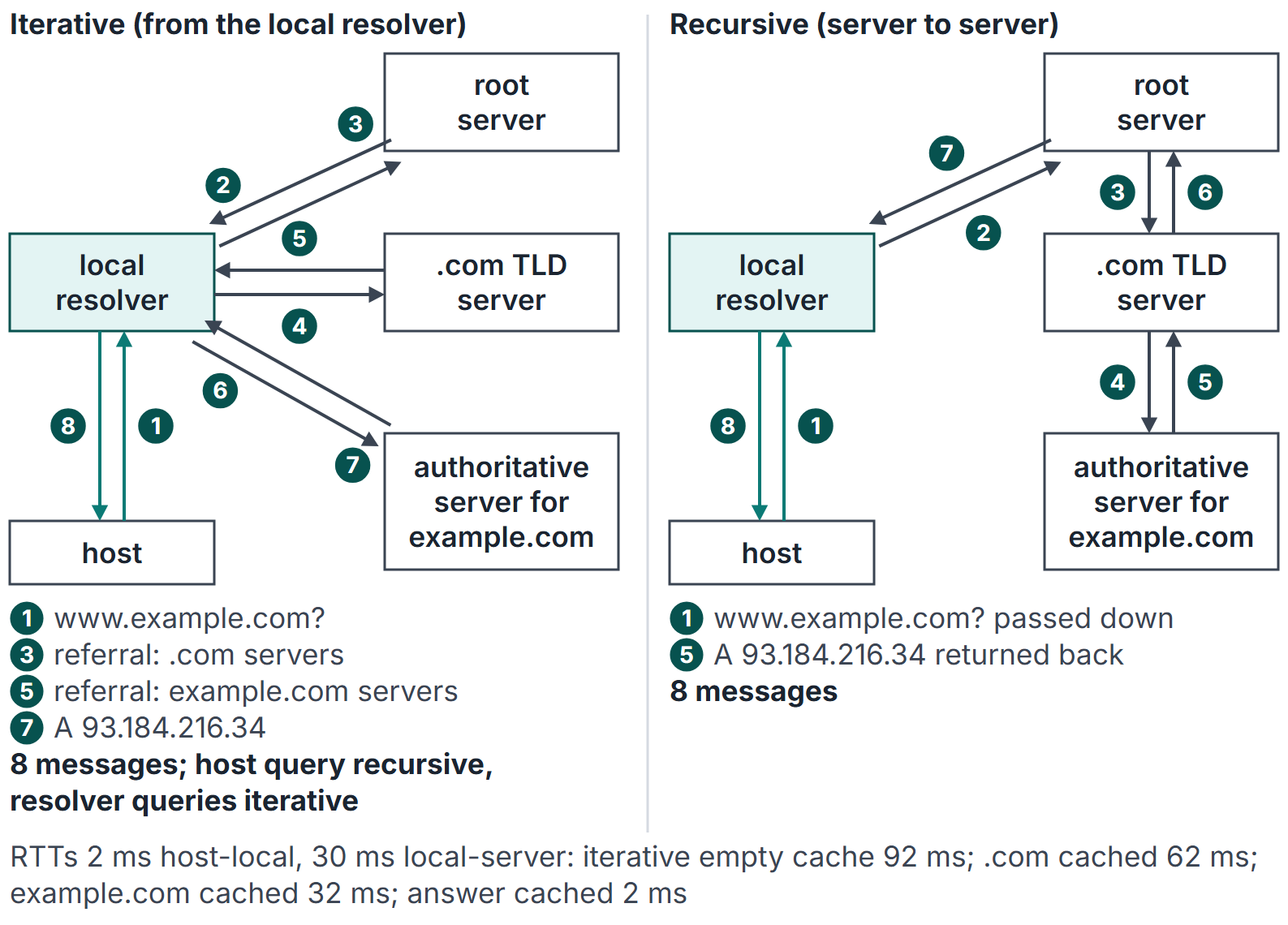
- Iterative query: the server answers with what it knows, either the answer or a referral ("ask these servers"). The asker then queries the next server itself.
- Recursive query: the server takes over and returns the final answer, querying other servers as needed.
A host's stub resolver usually sends a recursive query to its local resolver, which then resolves iteratively: root, then TLD, then authoritative.
Message format
Queries and replies share one format: a 12-byte header, then question, answer, authority and additional sections.
| Header field | Bits | Meaning |
|---|---|---|
| ID | 16 | Matches a reply to its query |
| QR, Opcode, AA, TC, RD, RA, Z, RCODE | 1, 4, 1, 1, 1, 1, 3, 4 | Query or reply; kind; authoritative answer; truncated; recursion desired; recursion available; reserved; error code |
| QDCOUNT, ANCOUNT, NSCOUNT, ARCOUNT | 16 each | Number of entries in each section |
Names are encoded as length-prefixed labels ending in a zero byte: www.example.com becomes 3 www 7 example 3 com 0, 17 bytes. A repeated name can be replaced by a 2-byte pointer whose top two bits are 11 and whose other 14 bits give the offset of an earlier copy (message compression).
Mathematical explanation: messages and delay
With empty caches and a three-level lookup (root, TLD, authoritative):
| Resolution | Queries | Messages | Delay |
|---|---|---|---|
| Host recursive to local, local iterative | 4 | 8 | |
| Fully recursive chain | 4 | 8 | |
| TLD servers cached at local resolver | 3 | 6 | |
| Authoritative servers of the zone cached | 2 | 4 | |
| Answer cached at local resolver | 1 | 2 |
Here is the host-to-local-resolver RTT and the local resolver's RTTs to the root, TLD and authoritative servers; in the recursive chain is the root-to-TLD RTT and the TLD-to-authoritative RTT. In general, a lookup that reaches servers beyond the local resolver costs messages. Caching is what makes DNS scale: each referral (NS records) and answer is reused until its TTL expires.
Worked examples
Example 1: delay with and without the cache
A host's RTT to its local resolver is 2 ms; the resolver's RTT to each of the root, .com and example.com servers is 30 ms.
- Empty cache: ms, 8 messages.
.comservers cached: ms, 6 messages (TLD, then authoritative).example.comservers cached: ms, 4 messages.- Answer cached: 2 ms, 2 messages.
Example 2: an alias
www.example.com has a CNAME record pointing to web1.example.net, which has an A record. A resolver asking for the A record of www.example.com gets the CNAME and must then resolve web1.example.net; if that name is in another zone, the lookup may need further referrals.
Example 3: mail
To send mail to [email protected], the sending server asks for the MX records of example.com, picks the one with the lowest preference number (for example 10 mx1.example.com before 20 mx2.example.com), then asks for that server's A record.
Example 4: name encoding
www.gate.example encodes as 03 77 77 77 04 67 61 74 65 07 65 78 61 6d 70 6c 65 00: bytes. A query for it is 12 (header) + 18 (name) + 2 (type) + 2 (class) = 34 bytes of DNS message, sent in one UDP datagram.
Example 5: reverse lookup
The name for address 203.0.113.7 is looked up as a PTR record for 7.113.0.203.in-addr.arpa: the bytes are reversed so that the most specific part comes first, as in every domain name.
Important properties and observations
- UDP for queries, TCP for zone transfers (and for answers too large for a UDP message).
- Root and TLD servers usually answer only iteratively; recursion is the local resolver's job.
- Caching with TTLs trades freshness for load: a changed record may be served stale until its TTL expires.
- A name may have several A records, which lets a site spread clients over several servers.
- DNS lookups come before connections: fetching a page from a new host starts with DNS.
Common misconceptions.
- "The local resolver is part of the hierarchy." It is a client of it, run near the host.
- "Recursive resolution needs fewer messages." Both need 8 here; recursion shifts the work, it does not reduce it.
- "DNS uses only TCP" or "DNS uses only UDP." UDP port 53 is common, but TCP is valid for ordinary queries and required for general-purpose DNS implementations. AXFR uses TCP, and truncation commonly triggers TCP retry.
- "Each label can be 255 bytes." 63 bytes per label; 255 for the whole name.
GATE examination perspective
- Message counts. Count queries and replies; caching removes pairs.
- Delay. Add the RTTs of each server actually contacted.
- Recursive versus iterative. Who issues the next query.
- Record types. A, AAAA, NS, CNAME, MX, PTR.
- Transport and port. UDP port 53; TCP port 53 for zone transfers.
Summary
Sources
- A. S. Tanenbaum, D. J. Wetherall, Computer Networks, 5th ed., Pearson, 2011: Section 7.1 (DNS), Subsections 7.1.1 to 7.1.3.
- J. F. Kurose, K. W. Ross, Computer Networking: A Top-Down Approach, 8th ed., Pearson, 2021: Section 2.4 (DNS: The Internet's Directory Service), Subsections 2.4.1 to 2.4.3.
- B. A. Forouzan, Data Communications and Networking, 5th ed., McGraw-Hill, 2013: Chapter 26 (Standard Client-Server Protocols).
- Root Server Technical Operations Association, Root Servers, (consulted 2026-11-11): the 13 root server identities A to M and their 12 operators.
- P. Mockapetris, RFC 1034, Domain Names: Concepts and Facilities, 1987, Section 4.3.1 (Queries and responses: recursive and non-recursive modes), (consulted 2026-11-11).
- P. Mockapetris, RFC 1035, Domain Names: Implementation and Specification, 1987, Sections 2.3.4 (Size limits), 3.2.2 (TYPE values), 4.1.1 (Header section format), 4.1.4 (Message compression), 4.2.1 (UDP usage) and 4.2.2 (TCP usage), (consulted 2026-11-11).
- J. Dickinson et al., RFC 7766, DNS Transport over TCP: Implementation Requirements, Sections 1, 4 and 5, (consulted 2026-11-11).