
Introduction
An algebraic structure is a set together with one or more operations that combine elements. Abstracting away from what the elements are (numbers, strings, permutations, matrices) and keeping only the laws the operation obeys lets one theorem cover all of them. Strings under concatenation form a monoid, which is why automata theory and parsing can use algebraic arguments; the integers modulo form groups that underlie hashing, checksums and public-key cryptography; permutations of a set form groups used in counting arguments.
The development follows the hierarchy semigroup, monoid, group, abelian group, then covers subgroups, cyclic groups and Lagrange's theorem. Rings and fields are defined at the end for reference.
Prerequisites
- Functions: a binary operation is a function ; bijections and composition.
- Modular arithmetic: is the remainder in ; .
Core concepts
Binary operations and their properties
A binary operation on a set is a function . Requiring the result to lie in is the closure property; subtraction is a binary operation on but not on ().
| Property | Statement |
|---|---|
| Associative | for all |
| Commutative | for all |
| Identity | some with for all |
| Inverse (given identity ) | for , some with |
| Idempotent element |
On an -element set there are binary operations (each of the table cells holds one of values) and commutative ones (only the diagonal and the cells above it are free).
The hierarchy
| Structure | Closure | Associative | Identity | Inverses | Commutative |
|---|---|---|---|---|---|
| Semigroup | Yes | Yes | |||
| Monoid | Yes | Yes | Yes | ||
| Group | Yes | Yes | Yes | Yes (every element) | |
| Abelian group | Yes | Yes | Yes | Yes | Yes |
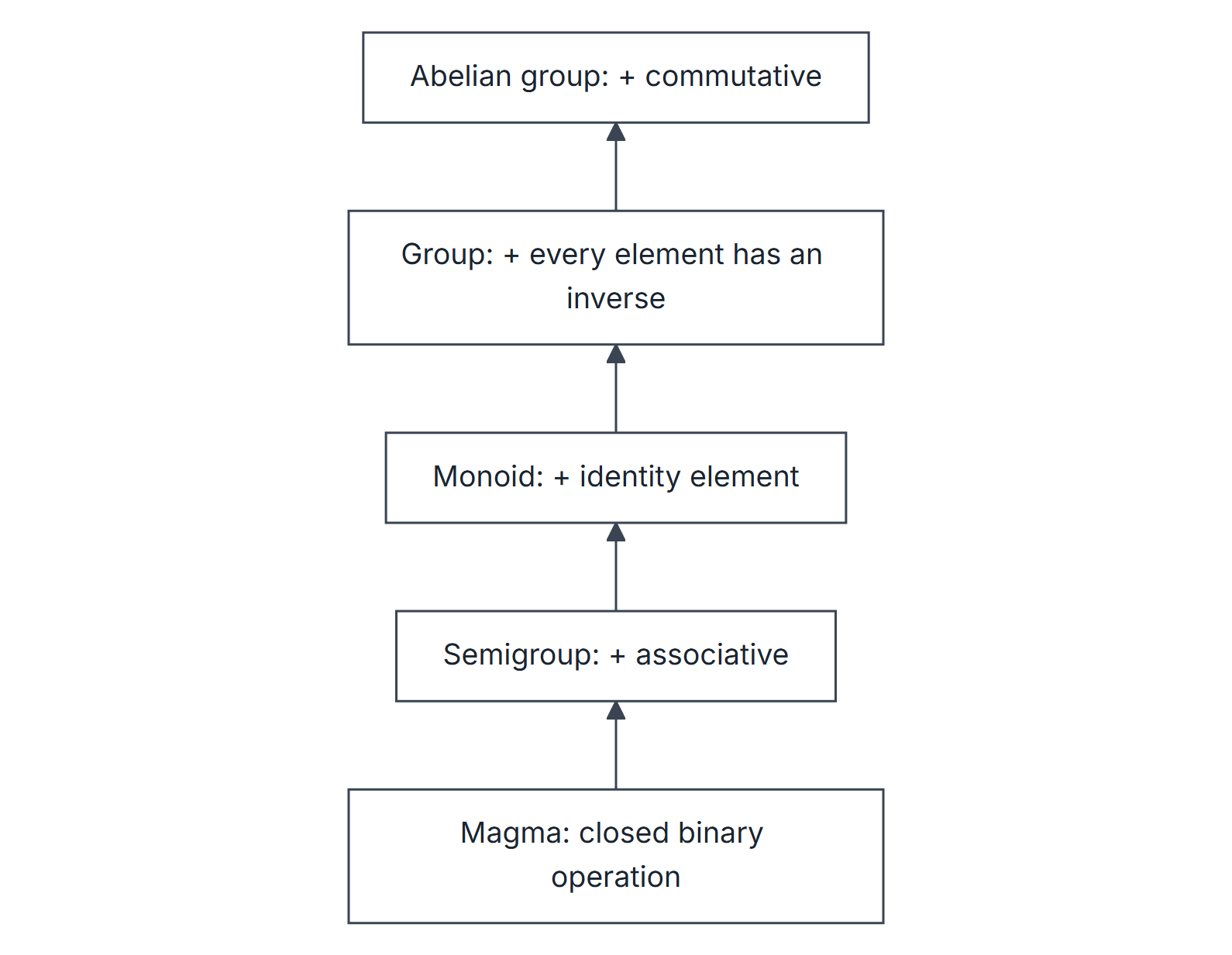
Some books call a set with just a closed binary operation an algebraic system or groupoid instead of a magma; the axioms above are what matter.
Examples and non-examples
| Set and operation | Semigroup | Monoid | Group | Abelian |
|---|---|---|---|---|
| Yes | Yes () | Yes () | Yes | |
| , with | Yes | Yes | No (no ) | n/a |
| Yes | No (no 0) | No | n/a | |
| Yes | Yes () | No (2 has no inverse) | n/a | |
| Yes | Yes | Yes | Yes | |
| No (not associative) | No | No | n/a | |
| , strings under concatenation | Yes | Yes () | No for a nonempty alphabet; yes for the empty alphabet | n/a for a nonempty alphabet (not a group); yes for the empty alphabet. Concatenation is commutative exactly when . |
| Yes | Yes () | No for ; yes for (trivial group) | Yes for ; n/a for (not a group) | |
| (symmetric difference) | Yes | Yes () | Yes () | Yes |
| , addition mod | Yes | Yes | Yes | Yes |
| , units mod | Yes | Yes | Yes | Yes |
| , permutations of objects | Yes | Yes | Yes | Only for |
| Invertible real matrices under product | Yes | Yes | Yes | Only for |
For these modular-unit examples assume . Here , of size (Euler's totient). is a group if and only if is prime.
Basic theorems
For a group with identity :
- The identity is unique. (If are identities, .) This holds already in a monoid.
- Each element has a unique inverse. (If are inverses of , .) Also holds for invertible elements of a monoid.
- and (the order reverses).
- Cancellation: , and .
- The equations and have unique solutions , . Hence in the Cayley table (operation table) of a finite group every element appears exactly once in each row and each column (a Latin square). This is necessary but not sufficient: a Latin square table need not be associative.
- If for every , then is abelian. (Proof: .)
Order of a group and of an element
- The order is the number of elements.
- The order of an element , written , is the least positive with (in additive notation, ); if none exists, has infinite order. , .
- For integer , if has finite order , then if and only if ; if has infinite order, if and only if .
- In , .
Subgroups
A non-empty subset is a subgroup () if it is a group under the same operation. Tests:
- One-step test: and .
- Finite test: if is finite and non-empty, closure under alone suffices.
The intersection of two subgroups is a subgroup; their union is a subgroup if and only if one contains the other.
Lagrange's theorem
If is a finite group and , then divides . The cosets partition into blocks of size , and their number is the index .
Consequences:
- divides (apply Lagrange to the subgroup generated by ), so .
- A group of prime order is cyclic, generated by any non-identity element, and has only the trivial subgroups and .
- The converse of Lagrange is false: the alternating group has order 12 but no subgroup of order 6.
- Applied to : when (Euler), and for prime (Fermat).
Cyclic groups
is cyclic if for some generator . Every cyclic group is abelian (the converse fails: the Klein four-group is abelian and not cyclic). Every subgroup of a cyclic group is cyclic.
For a finite cyclic group of order :
- the number of generators is ; in , generates if and only if ;
- for each divisor of there is exactly one subgroup of order , so the number of subgroups is the number of divisors of ;
- the number of elements of order is for each .
Every group of order 1, 2, 3, 5 or 7 (prime orders and 1) is cyclic; of order 4 it is either or the Klein four-group . Every group of order at most 5 is abelian; the smallest non-abelian group is , of order 6.
Rings and fields (definitions for reference)
- A ring : is an abelian group, is a semigroup (these notes also require a multiplicative identity 1, as in many modern texts; some books do not), and multiplication distributes over addition on both sides. Example: , , matrices.
- A field is a commutative ring with in which every non-zero element has a multiplicative inverse, so is an abelian group. Examples: , and for prime . is a field if and only if is prime.
Worked examples
Example 1: identify the structure
On , define . Closure: yes. Associative: . Identity: gives . Inverse: gives . Commutative: yes. So is an abelian group.
On , : associative and commutative, but no identity (it would have to be ), so a semigroup only. On (with 0), has identity 0, giving a commutative monoid that is not a group.
Example 2: element orders in
: ; ; ; ; ; . Generators: , that is . Subgroups: one for each divisor , six in all. The counts of elements of each order equal and add to 12.
Example 3: the group
, . Powers of 3 mod 10: , so 3 generates the group, which is cyclic of order 4. Inverses: (since ), . Lagrange check: divides 4.
Example 4: a non-abelian group
In with composition (apply the right permutation first), let and . Then sends , , , giving , while . Since these differ, is not abelian. Element orders in : one of order 1, three of order 2, two of order 3; all divide 6, but no element has order 6, so is not cyclic.
Important properties and observations
- A monoid's invertible elements form a group (the group of units).
- A finite semigroup with both cancellation laws is a group.
- Associativity cannot be read off a Cayley table at a glance; check it (or recognise the operation).
- In additive notation, the identity is 0, the inverse of is , and becomes .
- Groups of order ( prime) are abelian, though not necessarily cyclic ( has order 4).
GATE examination perspective
- Structure identification. Given a set and an operation (possibly a custom one such as ), check closure, associativity, identity, inverses and commutativity in that order. Check closure and the existence of inverses for every element carefully.
- Orders and generators. Use in , generators, one subgroup per divisor.
- Lagrange. Possible subgroup and element orders must divide ; remember the converse is false.
- Trap: is a group only for prime .
- Trap: , not , in a non-abelian group.
Summary
Sources
- J. A. Gallian, Contemporary Abstract Algebra, 8th ed., Brooks/Cole Cengage Learning, 2013: Chapters 2 (Groups), 3 (Finite Groups; Subgroups), 4 (Cyclic Groups) and 7 (Cosets and Lagrange's Theorem).
- K. H. Rosen, Discrete Mathematics and Its Applications, 7th ed., McGraw-Hill, 2012: Sections 4.1 (Divisibility and Modular Arithmetic) and 4.4 (Solving Congruences).